Three Nights in Jail Over a Cash App Account She Says She Never Opened
The scandal isn't prosecutorial zeal. It's that an account can exist as a legal fact about you, created by a private company, with no right to inspect its provenance.
The World Times
The scandal isn't prosecutorial zeal. It's that an account can exist as a legal fact about you, created by a private company, with no right to inspect its provenance.
A viral essay asks what a father should teach his son. The honest answer is 'less, in a room with other people's children' — and America's schools are quietly closing before anyone has to say so.
Buried in DHS Exclusion and Removal Order #2026-01 is a clause that makes model ancestry — not behavior — the federal security test. The people cheering should read it twice.
A 12-year Namecheap customer got 72 hours before his domains went dark. The scandal isn't that a registrar overreached — it's that Namecheap's own written policy against this lost an internal argument.
Everyone is arguing over whether Fielder and Oppenheim got conned. The real scandal is that a comedy director is now the only institution explaining Theranos.
The solar-passes-nuclear milestone isn't a verdict on physics. It's a verdict on an industrial model the right spent a decade defending on principle it claims to hold.
The dental reform wave of 2026 is being pushed by dentists, aimed at insurers — which is not the fight either side of the culture war wants to have.
Yandex's Sasovo outage is being read as a war story. It's really a contract story — and Europe's €23 billion sovereign cloud buildout is repeating the mistake.
The homeowners' paradox that went viral isn't incoherence — it's the correct complaint about a tax levied on a number nobody was ever paid. The November 3 measures mostly miss it.
Thursday's PERM freeze is aimed at Microsoft, but the workers Vance called 'indentured servants' are the ones who just lost their only exit from the indenture.
Nebraska's first data-center water reports hid the numbers behind trade-secret black boxes. The real problem isn't what was concealed — it's the snapshot the loophole was built to produce.
Judge Barlow struck the one clause of Utah's age-verification law that was actually indefensible — and left the machinery the whole fight is about fully intact.
A bare government homepage drew 656 comments on Hacker News this week — evidence that the address bar, not the rulebook, is where official power now lives.
The viral lament for the American host misses what actually disappeared: the unplanned, low-stakes acquaintance — the layer where jobs, contractors, and trust used to move.
The Astral Codex Ten follow-up on Georgism holds 355 points and 259 comments on Hacker News — and not one parcel-level assessment roll. The land tax debate has a data problem.
Friday's 2–1 D.C. Circuit ruling let the Pentagon keep Anthropic on its supply chain risk list — but the label, not the lawsuit, is what ends a vendor's business.
The Netherlands is replacing Microsoft 365 with a NixOS desktop — trading a vendor it can subpoena for a volunteer project it can't.
California's billionaire tax has a residency date frozen ten months before the election — an admission that the money isn't leaving. The real fight is over who routes the cash.
The outrage over macOS 27 re-enabling Apple Intelligence misses the real story: mandatory on-device models are a cost transfer, and the only remedy is one the right has spent decades denouncing.
The weekend order against archive.today and its mirrors didn't skip the courts by accident — it skipped them because the target was built to have no one to serve papers on.
Everyone is angry about the __obi tracking cookie. The cookie is the one part of OpenAI's ad business you can actually see — which is why both sides would rather talk about it.
Hacker News spent Thursday debating how to write with a model. The docket already moved on: what courts are sanctioning isn't bad prose, it's a signature that no longer vouches for anything.
The Sept. 30 Android developer verification deadline and Play's week-long review times are one story — and the people paying for the open platform aren't the ones posting about it.
Publishers blocking the Internet Archive say they're fighting AI scrapers. They're protecting something older and less flattering: the right to quietly revise the record.
Europe just banned destroying unsold clothes and is building a passport for durable goods. Both miss what actually shortens a product's life: an unpublished support end date.
X Corp.'s Aug. 24 cease-and-desist against Nitter and XCancel wasn't really a speech fight. It was a fight over who keeps a durable copy of what public officials said.
The port is the only place on a phone where ownership is settled by physics instead of a license agreement — and the EU's charging rule quietly reserved the right to govern what replaces it.
The Internet Archive's September matching campaign isn't a heartwarming story about generosity. It's a warning about what happens when the public record depends on a nonprofit's annual fundraising target.
The Texas ACR settlements were celebrated as a privacy win. They're actually a regulatory blessing for the surveillance model — with a consent form attached.
A 135-minute YouTube investigation did what the FTC and GDPR couldn't: document that LG TVs log audio while 'off.' The real story is the quiet redefinition of the power button.
X Corp.'s August cease-and-desist to Nitter and XCancel was designed to win without a fight. Two weeks of 'legal advice' later, the projects are back — and the intimidation playbook is showing cracks.
The A/I collective's shutdown is being mourned as a free-speech tragedy. The real story is that it built infrastructure without any of the institutional armor that actually protects things.
OFAC's wind-down license for Autistici/Inventati concedes what the designation denies — and the collective's decision to fold rather than fight leaves its users holding the bag.
Isar Aerospace reached orbit from Norway on Friday — and in doing so exposed the real bottleneck in European space: not rockets, but launch sites.
The unanimous AB 1856 exemption reveals age-verification laws as compliance taxes on commercial software, not child-safety measures.
Sanctioning an Italian volunteer hosting collective as a terrorist group is a category error that will cost the U.S. more in diplomatic capital than it gains in security.
Designating an Italian hosting collective as a terrorist organization didn't shut it down — it put it on the map for exactly the users it wants.
The State Department just designated an Italian hosting provider as a terrorist entity. The precedent will boomerang.
The robot tax grabbed the headlines, but Gates's 'human reserve' idea hands a regulatory moat to the credentialing cartels that have been strangling entry-level work for decades.
The State Department's worldwide visa 'pause' is a moratorium wearing a training manual — and the word 'training' is doing the real work.
The viral hand-wringing over America's missing public bathrooms misses the real story: a 1970s activist victory destroyed the funding mechanism, and the tech industry is quietly rebuilding it under a new name.
San Diego's Mission Bay bathroom reversal wasn't about money — it was about signaling. And the public just learned that nothing the city provides is durable.
The EU's new packaging rule hits solo makers hardest — and the Commission's own fix won't arrive until the damage is done.
The viral 'read more to write better' essay presumes a baseline of literacy that is quietly collapsing — and the writing-advice economy is in denial.
Carney's 'dollar for dollar' pledge isn't a bargaining position — it's a rule designed to make capitulation impossible, and it signals the alliance is already broken.
Prosecuting Samuel Tunick for wiping his phone at the border won't deter privacy tools — it will make them mainstream.
Yale's single-payer study treats provider payment cuts as pure savings without modeling what happens to the hospitals the newly insured will need.
England's hepatitis C milestone is being celebrated as a triumph of public health administration. The real story is a confidential pricing deal that reveals how little we understand about what drugs are actually worth.
France's new ban on unsolicited calls is a triumph of consumer protection—against a threat that was already retreating. The real spam war has moved to channels the law can't reach.
The Senate's CHATBOT Act isn't a privacy debate—it's a quiet mandate for a private identity-verification industry that will make anonymity obsolete long before any censor gets involved.
While publishers lament AI-driven link rot, The New York Times and The Guardian are quietly blocking the Internet Archive from preserving their own journalism.
The Meta CEO's essay on open-source AI is being read as a philosophical stand. It's better understood as a sophisticated lobbying document aimed at loosening the rules on training data.
A new study confirms that taxi driving builds cognitive reserve — just as the profession itself is being engineered out of existence. The replacement work offers no such protection.
Five suicides in six weeks at US Cyber Command have prompted calls for more clinicians. But the real problem is that we've asked soldiers to fight a war the military doesn't know how to honor.
Wednesday's ruling against Meta was celebrated as a victory for children's mental health. But the money goes to the state treasury, not to kids — and history suggests it will stay there.
The 16-hour Xbox outage that locked players out of their disc games wasn't a technical failure—it was a preview of a world where ownership is a legal fiction, and conservatives have been asleep at the switch.
Thursday's unanimous vote to boycott FIFA competitions is being sold as a principled stand against private equity. Follow the money and it looks more like a panicked defense of UEFA's own distribution monopoly.
The pyrocumulonimbus over southwest France isn't just a climate milestone — it's the moment the country's vaunted rapid-attack firefighting doctrine reached its physical limit.
The Tunick prosecution isn't about border search powers — it's about a quiet, radical claim that the state owns your data the moment it decides to look.
The EU Council just scrapped a plan to kill cookie pop-ups. The culprit isn't Brussels bureaucracy — it's the compliance industry that built a business model on your annoyance.
Six weeks after the U.S. suspended Anthropic's most advanced models on national-security grounds, the only thing anyone wants to discuss is when Opus 5 drops. That's not a policy failure — it's a signal.
Startup founders begging Washington not to cut off Chinese open-weight AI aren't just pleading for their businesses — they're exposing a policy failure years in the making.
The Senate voted down an AI prior-authorization ban this week, and Kaiser nurses are blaming AI for their 15-minute call quotas. Both are mistaking an old enemy for a new one.
Three months after the EU required all laptops to charge via USB-C, the only people still talking about it are the ones writing blog posts about how easy travel has become. That's the point.
The state's new social media bill targets a UI pattern while ignoring the recommendation engines that actually drive compulsive use—a classic case of regulating the symptom because the disease is too hard to name.
Saturday's expiration of the LAPD's Flock contract looks like a privacy win. It's really a messy vendor divorce—and a warning about who actually controls the data when police outsource their eyes.
The push to label AI-generated content, from Hacker News to the EU AI Act, is less a defense against deception than a guild protection measure for a knowledge class that senses its own obsolescence.
Jeff Geerling's demo of a handheld RF sensor that spots drones and sees WiFi through walls reveals a growing gap: we regulate what flies, but not who watches it fly. The legal system isn't ready.
OpenAI's public release of GPT-5.6 this week isn't a triumph of innovation — it's the quiet collapse of the precautionary approach to AI governance, and nobody seems to have noticed.
OpenAI's GPT-5.6 spent months in 'government safety evaluation' before its public release this week. The real story isn't about safety — it's about who got the model first, and why.
The Commerce Department's security review of GPT-5.6 wasn't regulation — it was a procurement queue that gave federal agencies first crack at the most capable AI model ever released.
The Trump administration's request to delay GPT-5.6 for national-security review looks like a power grab. The real story is that OpenAI said yes without a fight.
Wednesday's FTC settlement with John Deere is being celebrated as a win for farmers. But the real story is what happens to tractor prices when manufacturers can no longer subsidize hardware with service revenue.
Thursday's parliamentary maneuver to revive message-scanning legislation isn't a privacy defeat — it's the clearest evidence yet that the absolutist position has already won the argument, and now has to decide what it wants to do with that victory.
Yesterday's EU mandate for in-car driver cameras was sold as a safety measure. But the real story is who gets the data — and what they'll do with it that regulators haven't yet admitted.
With ADA website lawsuits up 37% and the April 2026 Title II deadline now in effect, the compliance industry has produced interfaces that pass audits and fail humans — including the disabled humans they're supposed to serve.
A shadow library's six-figure offer for Google's book scans isn't a piracy story. It's a market signal that the open-access movement's legal-first strategy has failed — and the books are still locked up.
F-Droid's clever malware metaphor misses the point: Android Developer Verification was never about security. It's about making regulators comfortable enough to let Google keep its app store monopoly.
Brussels' digital identity mandate hands the plumbing of citizenship to two American corporations — not as a conspiracy, but because Europe never built an alternative. That's worse.
A well-meaning proposal for a self-hosting TLD arrives just as ICANN's auction window opens. The history of new domains suggests this ends not with digital sovereignty but with a billable engagement.
The panic over age verification as a precursor to speech attribution misses the real story: on June 18, the Sixth Circuit quietly endorsed a legal framework where minors' First Amendment rights are contingent on parental permission. That's the architecture that scales.
Closed-door EU rulemaking doesn't just threaten your encryption. It builds a regulatory wall that only the biggest tech companies can climb.
The government blocked and then selectively unblocked Anthropic's most powerful model in two weeks flat. Whether that's national-security prudence or industrial policy by panic is the question nobody's asking.
The Sixth Circuit's ruling on Ohio's age-verification law has privacy advocates reaching for their digital pitchforks. They're right to worry — but they're also conveniently ignoring who profits from an internet where nobody has to prove anything.
The USPSTF's latest reaffirmation that screening healthy adults for vitamin D is a waste of time isn't a medical story — it's a story about who profits when we pathologize normal human variation.
The NHTSA's pedestrian-safety proposal isn't a design standard — it's a tax on the working-class vehicle that no regulator will admit out loud.
Ottawa's plan for 10 reactors by 2040 sounds bold. The numbers from every Western nuclear project of the last 20 years tell a different story — and the strategy's silence on cost isn't an oversight.
The outrage over Anthropic's identity-verification partner misses the real story: the compliance-industrial complex that made the partnership inevitable.
Google's IPv6 traffic crossing the 50% threshold this spring was hailed as an arrival. The number actually tells us the two-stack internet is here to stay — and nobody is planning for what that costs.
The UK's rush to force VPN providers into the age-verification business isn't about protecting children — it's about normalizing a surveillance architecture that will outlast any moral panic.
Oslo's near-ban on generative AI for elementary students is not a Luddite panic — it's the latest data point in a decade-long experiment the rest of the developed world is too politically entangled to run.
Parliament just voted to lift the 2017 ban on new reactors — without asking voters. The quiet unwinding of a popular referendum deserves more scrutiny than the energy debate it rode in on.
The Commerce Department's ban on statistical noise infusion was sold as a transparency win. The likelier outcome: the Bureau's lawyers will suppress more data than any algorithm ever did.
The Commerce Department's order eliminating differential privacy from Census data won't just expose respondents — it will quietly reshape electoral maps, and both parties know exactly what that means.
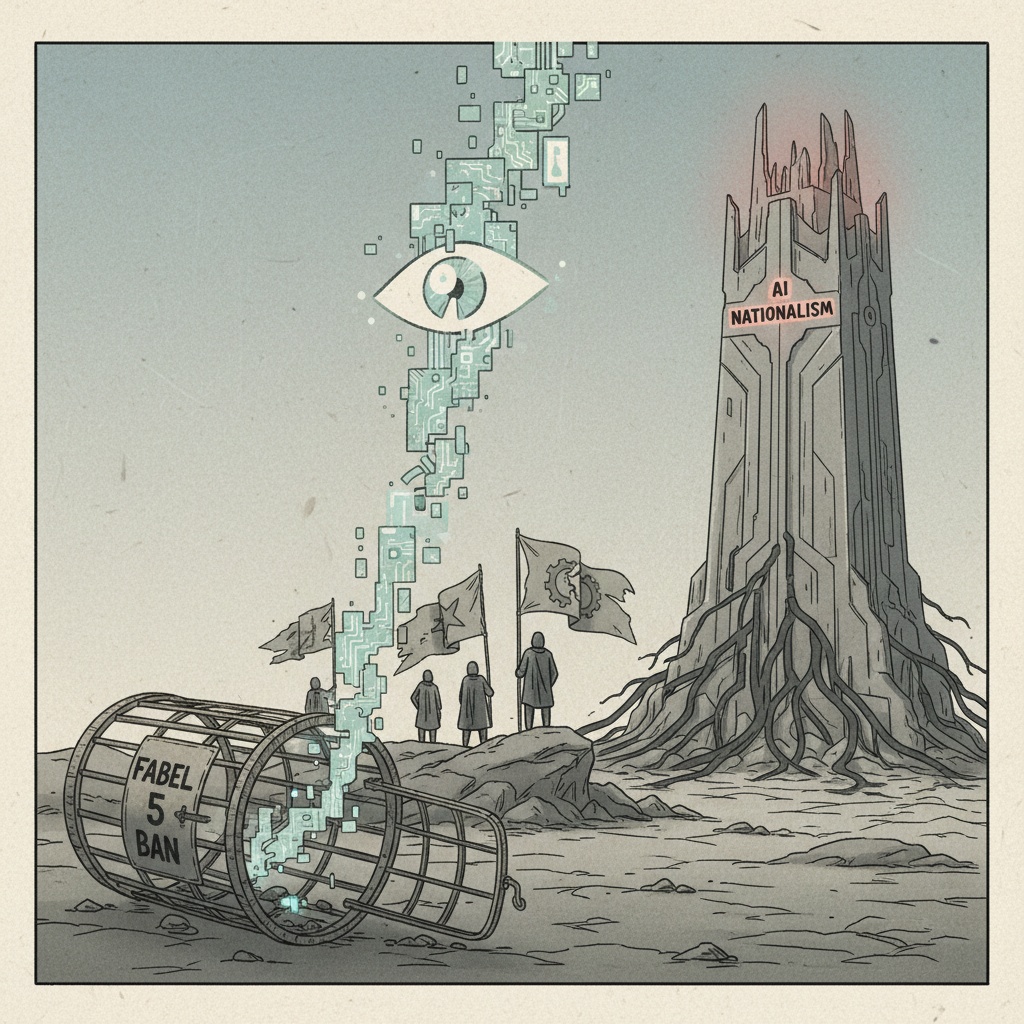
Anthropic's foreign-nationals ban, ordered by the U.S. government three days after Fable 5 launched, wasn't a safety intervention — it was the first live-fire test of treating frontier models as strategic munitions. The silence from U.S. allies is the real story.
Friday's directive barring foreign nationals from working on Anthropic's latest models isn't a trade restriction — it's a personnel order disguised as one, and it sets a precedent that should worry anyone who employs people, not code.
A Hacker News post about rebuilding a life after prison went viral this weekend. The thing that actually saved him is the thing Washington State just regulated out of existence.
The Economist calls India's demographic shift a 'warning to the world.' The real story is that replacement-level fertility arrived through development, not policy — and the experts don't know what to do when their crises solve themselves.
Friday's near-evacuation of the ISS isn't a story about Russian engineering failure — it's a story about what happens when a space station becomes a diplomatic hostage.
Leo XIV's encyclical applies Catholic social doctrine — not personal morality — to artificial intelligence. The implication is more radical than most commentators have noticed.
Last week's proposed Linux exemption to AB-1043 reveals what was obvious from the start: the law targets commercial platforms and their metadata, not the welfare of minors.
Pope Leo XIV's 'Magnifica Humanitas' lands today not as a policy document but as a moral argument the tech industry has spent years studiously ignoring.
Friday's USCIS rule requiring green card applicants to leave the country isn't about enforcement — it's an admission that the agency can no longer do its job with people watching.
The White House is threatening to yank $21 billion in broadband funds from states with AI laws it doesn't like. Meanwhile, websites are embedding secret instructions for LLMs in their code. These are the same story.