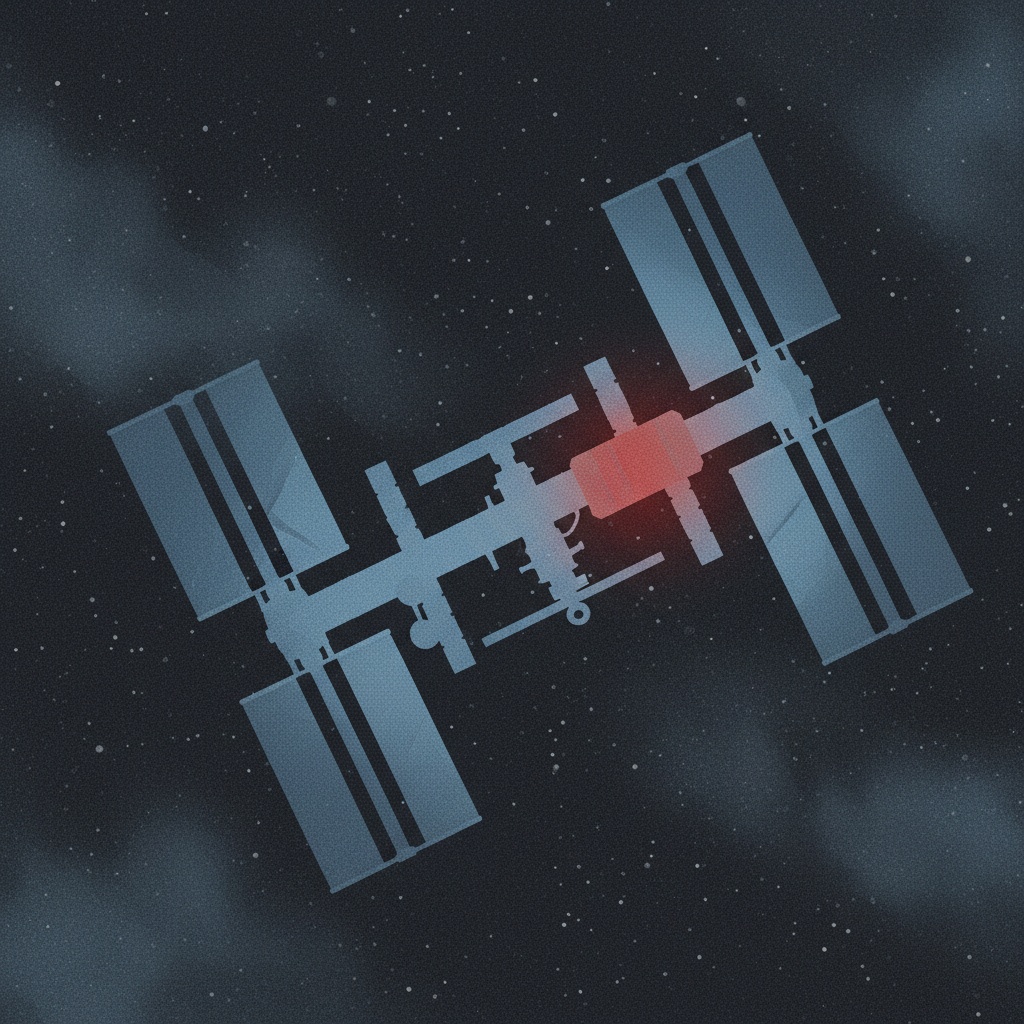
At 9:04 a.m. Eastern on Friday, NASA mission control gave an order that no one in human spaceflight ever wants to give: five astronauts aboard the International Space Station were told to shelter in their Crew Dragon capsule and prepare for a possible evacuation. A worsening air leak on the Russian side of the station — one that Roscosmos crews had been chasing for months — had finally forced the kind of contingency drill that makes the phrase “abundance of caution” sound like a euphemism for “we are not entirely sure this thing is going to hold together.”
Roughly two hours later, NASA reversed the order. The repair work, a Roscosmos spokesperson explained, had progressed far enough that the crew could return to normal operations. Crisis averted. Deep breath. Move along.
The problem is that this is the third time in two years that a Russian module leak has triggered a shelter-in-place or equivalent alert on the ISS. The first was the Soyuz coolant leak in December 2022. The second was another coolant leak on a Progress cargo ship in February 2023. And now this — a persistent pressure loss in the Zvezda service module that Roscosmos has been patching, repatching, and repatching again since 2019, according to NASA’s own ISS advisory committee.
You will hear two takes on this in the next few days. The first will be some version of “Russian spaceflight is in decay, what do you expect.” The second will be “NASA’s safety culture worked — the system performed exactly as designed.” Both are true. Both miss the actual story.
The Station That Cannot Say No
The ISS is not a NASA station. It is not an American station. It is a legally entangled condominium orbiting 250 miles up, governed by an intergovernmental agreement signed in 1998 that gives each partner agency — NASA, Roscosmos, ESA, JAXA, and CSA — operational control over its own modules and hardware. If Roscosmos wants to keep flying a module with a leak it cannot permanently fix, NASA has essentially no authority to force a different decision. The station’s legal architecture was built for cooperation among equals. It was not built for a scenario in which one partner’s hardware becomes a persistent safety risk and that partner is simultaneously waging a war that has made it an international pariah.
This is not a hypothetical tension. It is the actual operational reality of the ISS in 2026. Russia has announced plans to leave the station partnership in 2028 — a date that has slipped repeatedly — but in the meantime, NASA astronauts are living and working in a structure where one wing is maintained by an agency whose quality-control problems are documented, recurrent, and politically impossible for anyone in Washington to address directly.
A former NASA flight director I spoke with on Friday afternoon, standing outside Building 30 at Johnson Space Center after the all-clear, put it this way: “Everyone in that room knows which module is the problem. Nobody in that room can say it out loud. So we just keep running the procedures.”
Interdependency Without Leverage
What makes this genuinely dangerous — and what the “Russian decline” narrative obscures — is that the ISS is not two separate stations bolted together. The Russian Orbital Segment provides propulsion, attitude control, and reboost capability. The U.S. Orbital Segment provides power, life support, and data. Neither side can operate the station without the other. This was a feature when the station was designed, a deliberate engineering choice meant to make defection costly and cooperation mandatory. It worked beautifully for two decades.
It works less beautifully when one partner’s hardware starts springing leaks and that partner’s geopolitical priorities have shifted away from the entire collaborative framework. The Zvezda module, where Friday’s leak originated, was launched in 2000. It is now the oldest pressurized module on the station, and Roscosmos has been managing a persistent small leak in its transfer tunnel for roughly seven years. The leak rate has fluctuated — sometimes stable, sometimes accelerating — and the root cause has never been publicly identified with certainty. Roscosmos engineers have attributed it to everything from micrometeoroid damage to manufacturing defects to fatigue cracking, depending on the month.
A NASA Aerospace Safety Advisory Panel report from late 2025 noted that the leak rate in Zvezda had increased to its highest level since monitoring began, and that the “source remains not fully characterized.” That is the kind of language safety boards use when they want to scream but have to whisper.
The Replacement That Will Arrive Too Late
There is an answer to all of this, and it is not diplomacy. It is Axiom Space’s commercial space station module, the first piece of which is supposed to dock with the ISS in late 2026 or early 2027 as a precursor to a fully commercial station. But Axiom’s timeline has been slipping, and the full commercial replacement for the ISS is not projected to be operational until the early 2030s at best. In the meantime, NASA astronauts will keep flying on a station whose Russian half is aging faster than anyone planned for, under an agreement that gives the United States no unilateral authority to demand fixes.
Friday’s shelter order lasted two hours. The next one might not be a drill. The fix for that is not better leak-patching — it is accelerating the schedule for a station that does not depend on a partner whose priorities no longer align with our own.
The irony is that Congress has known this for years. The ISS transition plan has been debated, funded, underfunded, reauthorized, and re-litigated through three administrations. What Friday’s scare makes clear is that the timeline is not academic. It is measured in the time it takes for a small leak to become a big one, and for a two-hour shelter order to become something permanent.
Sources
- Astronauts on International Space Station told to shelter as repairs …
- Astronauts aboard ISS briefly ordered to shelter amid air leak repairs …
- The moment NASA asked ISS crew to take shelter over air leak
- ISS astronauts face possible evacuation after air leak worsens
- Astronauts aboard ISS briefly ordered to shelter amid air …
- Air leak scare for astronauts on International Space Station