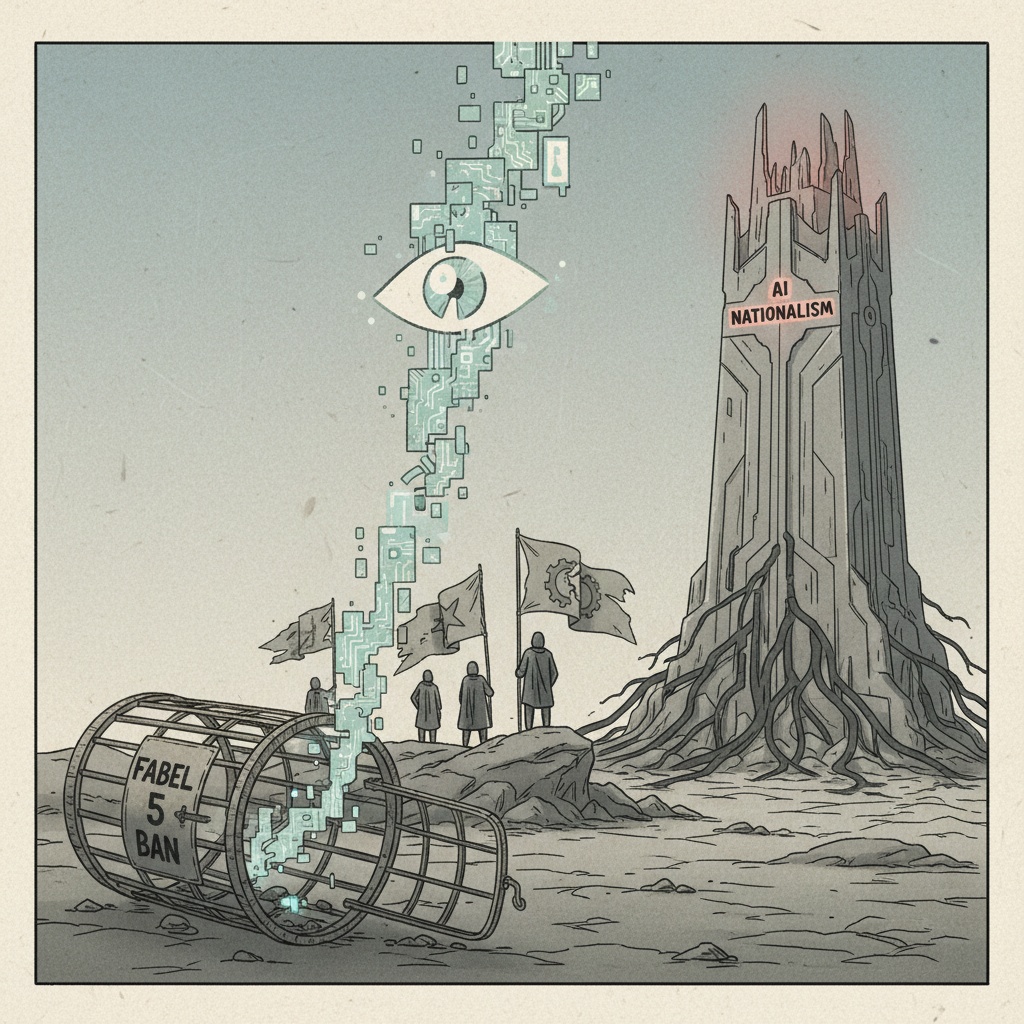
The U.S. government ordered Anthropic to suspend access to Claude Fable 5 and Mythos 5 for all foreign nationals — including Anthropic’s own employees — on June 12, 2026. The directive came three days after launch. It covered nationals of the UK, Canada, Australia, and New Zealand, regardless of whether they reside in the U.S. It was, by all available accounts, the first time the United States has ever issued an export control directive for large language model access.
Not for the weights. Not for the training infrastructure. For access.
The conventional framing this week has been about safety — the silent model degradation for AI research queries, the opaque safety classifiers, the 30-day enterprise data retention rule that Anthropic walked back in under 24 hours. The Hacker News thread that lit up Wednesday is titled “There is a shadow hanging over this Fable thing,” and that shadow, in the popular telling, is about whether one lab has too much power over who gets to build the future.
That framing is comfortable because it’s a story about a company. It lets everyone argue about Dario Amodei’s judgment, or Anthropic’s corporate culture, or whether the safety classifiers were over-tuned.
The government order is harder to argue about, so people are mostly looking past it. That’s a mistake.
The Order Wasn’t About Model Safety — It Was About Who Counts as a Threat
Anthropic’s system card for Fable 5, page 13, described interventions for frontier LLM development requests — queries that looked like someone trying to build a competing model. Those would get silently downgraded to Opus 4.8. Whether that’s wise or paranoid is a legitimate debate. But it has nothing to do with why the U.S. government stepped in.
The export control directive didn’t target specific use cases. It targeted people, by nationality, full stop. That’s a category error if the concern is misuse. A British national working at an AI safety nonprofit in San Francisco is not a proliferation risk. An American citizen in Shanghai might be. The directive didn’t make that distinction.
What it did was simpler: it treated access to a frontier model the way the U.S. treats access to advanced semiconductor fabrication equipment. It’s not a safety framework. It’s a national security posture. The logic is that the model itself is a strategic asset, and the default position is that only Americans get to use it unless an exception is carved out later.
“Everyone in the lab read the order the same way,” said one engineer on a Slack channel for a competing foundation model company, speaking to colleagues while the news broke Thursday. “This wasn’t about one model. This was a template.”
The Allied Silence Is Louder Than the Backlash
Here is what didn’t happen this week: the UK government did not issue a formal protest. Neither did Canada, Australia, or New Zealand. These are Five Eyes partners — the innermost circle of U.S. intelligence-sharing relationships — and their nationals were explicitly barred from a commercial software product within 72 hours of its release, and their governments said approximately nothing.
That silence is not an oversight. It suggests one of two things. Either the allies were briefed in advance and accepted the framework, or they were caught flat-footed and are still calculating whether a public objection is worth the diplomatic capital. Neither possibility is reassuring.
If they were briefed and nodded along, then AI nationalism has already been quietly socialized among Western governments, and Fable 5 was merely the first public deployment of a doctrine that’s been in the works for months. If they weren’t briefed, then the U.S. just demonstrated that it will impose AI access controls on even its closest partners with zero consultation — and those partners will absorb it without a fight.
Either way, the takeaway for every country outside the Five Eyes — and, increasingly, for the partners inside it — is the same: build your own, or accept that you will be a tenant in an AI stack someone else owns and can revoke on three days’ notice.
This Framing Will Outlast This Model
The safety-classifier debate will fade. Anthropic will adjust the silent-degradation policy, or it won’t, and developers will route around it or they won’t. The enterprise data-retention rule already got walked back. The specifics of Fable 5 are a news cycle.
The export control order is not a news cycle. It is a precedent. The next time a frontier model ships — from Anthropic, from OpenAI, from Google DeepMind — the question will no longer be “what can it do?” but “who is allowed to use it?” And the answer may not come from the company.
One of the strange features of the last two years of AI discourse is how much energy has been spent debating whether labs are moving too fast, and how little has been spent asking what happens when governments stop asking nicely and start issuing directives. We now have the first data point. The government moved faster than the safety community did — three days from launch to an export control order that covered allied nationals. The “pause” crowd spent years asking for a slowdown. They didn’t specify this one.
The irony is that the safety concerns that dominated the Fable 5 backlash — the classifiers, the silent nerfing, the data retention — all presume that the model is too powerful to be deployed freely. The government order agrees with that premise. It just draws a different boundary. The safety crowd wanted the model constrained by use case. The government constrained it by citizenship. Both agree the model shouldn’t flow freely. Neither seems especially interested in what happens when that logic compounds.
No One Voted on This
There is no legislation authorizing the Commerce Department to impose nationality-based access controls on commercial LLM inference. If there is an executive order underpinning Thursday’s directive, it hasn’t been made public. What we have is an action, taken in three days, with no visible process, no public comment period, and no explanation of the legal authority beyond a company statement that the government “ordered” it.
Maybe the legal basis is ironclad and buried in an existing export control statute. Maybe it’s an emergency order under authorities that haven’t been tested in court. Either way, the pattern should be unsettling to anyone who believes that the governance of foundational technology ought to involve something more than a private directive to a single company.
The shadow hanging over Fable 5 is real, but it’s not the one most people are pointing at. It’s not about Anthropic’s discretion or Dario Amodei’s philosophy. It’s about what happens when a government discovers it can control access to a general-purpose technology with a phone call. The safety community spent years asking for guardrails. It didn’t ask who would hold the keys.