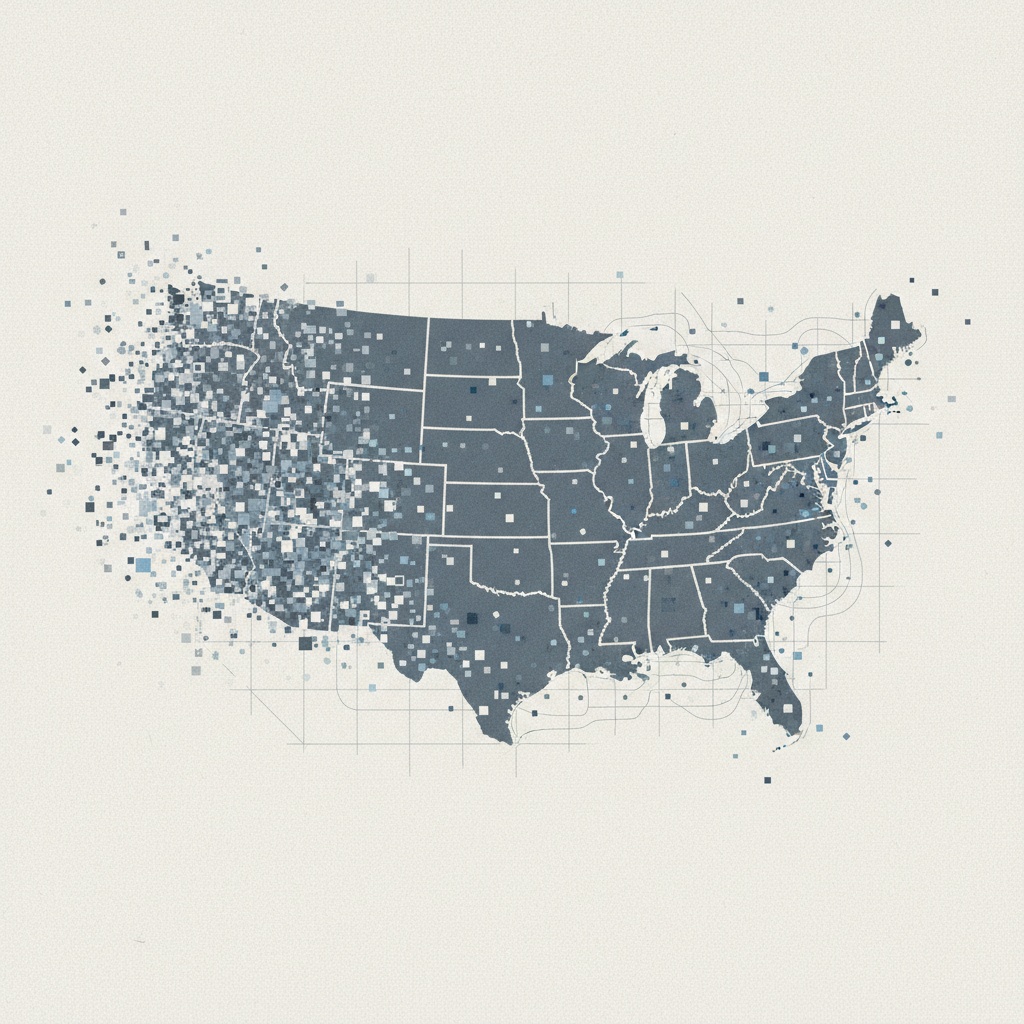
On Wednesday, the Commerce Department issued Department Administrative Order 216-26, banning the Census Bureau and the Bureau of Economic Analysis from using “noise infusion” — the practice of adding small, randomized perturbations to published statistics to prevent individual respondents from being reverse-engineered out of aggregate data. The order, signed by Commerce Secretary Cantor, effectively kills differential privacy as the Bureau’s disclosure-avoidance framework, sending statisticians and data journalists into a familiar spiral of alarm.
The NPR story that broke the news frames this as yet another Trump administration assault on empirical governance — another brick pried from the edifice of neutral, technocratic state capacity. The wonks are worried about re-identification attacks. They should be.
But they’re missing the actual fight.
The Redistricting Map Doesn’t Care About Your Privacy
Differential privacy was never primarily about protecting individual Census respondents. The Bureau already had legal obligations under Title 13 to keep personally identifiable information confidential for 72 years, and nobody seriously thinks a motivated adversary needs Census microdata to find out where you live. The real function of noise infusion in the decennial Census was to constrain what could be done with the data downstream — specifically, how granularly state legislatures could draw congressional districts.
The 2020 Census rollout of differential privacy triggered a ferocious backlash not from civil libertarians but from redistricting professionals in both parties, who discovered that noisy block-level counts made it significantly harder to carve districts with surgical precision. The Alabama state legislature’s 2021 lawsuit against the Bureau wasn’t about privacy — it was about whether fuzzed population counts would prevent them from drawing the districts they wanted to draw.
What the Commerce Department just did is hand those legislatures back their scalpel.
The Quiet Consensus No One Admits
There is a surface-level disagreement here — Republicans want small government, Democrats want rigorous data collection — and then there is the actual alignment of interests, which is far messier. Both parties’ redistricting lawyers have spent decades perfecting techniques that map Census block data onto voter-file microtargeting models. Noise is the enemy of precision, and precision is the currency of gerrymandering.
A Democratic redistricting consultant I spoke with on Thursday — on the condition that I not name his firm, because they’re currently under contract in three states — put it bluntly: “Look, we all hated the noise. Our models broke. We spent two years litigating the 2020 numbers. Nobody in this business wants differential privacy back. The difference is we’re not the ones who can admit it publicly.”
He’s not wrong. The progressive data infrastructure — from the DNC’s tech apparatus to the academic political science departments that supply expert witnesses in redistricting cases — spent 2020 through 2023 quietly fuming about the disclosure-avoidance framework while publicly defending it as necessary for privacy. Wednesday’s order forces a reckoning they’d rather not have.
What the Wonks Are Right About
Let’s grant the statisticians their due: the older methods of disclosure avoidance — primarily data swapping — were not designed to defend against the database reconstruction attacks demonstrated by the Census Bureau’s own researchers in 2018 and 2019. Those attacks showed that swapping records between tracts was trivially defeated if an adversary could cross-reference multiple tables. The Bureau itself published the research; it wasn’t hypothetical.
A senior statistician at a federal statistical agency — not the Census Bureau, and insistent on anonymity because his agency might face a similar order — told me the long-term risk isn’t individual exposure but a more corrosive form of distrust. “If people believe filling out the Census will get them doxxed, response rates drop, and suddenly you’re not just missing small-area data — you’re missing the whole baseline. Nobody wants to go back to imputing entire neighborhoods.”
He has a point, though it’s worth noting that the doomsday scenario of widespread non-response has not materialized in the decades when the Bureau used weaker disclosure methods, and the 2020 Census — the first with differential privacy — saw its own response-rate struggles for reasons that had nothing to do with algorithmic noise and everything to do with a pandemic and a citizenship-question fight.
The Realignment Nobody Is Naming
The story beneath the story is that the old partisan alignments around data governance are dissolving. For years, the right attacked statistical agencies as intrusive, while the left defended them as essential infrastructure. But when differential privacy arrived, the practical stakes inverted: the left discovered that fuzzed data made it harder to prove Voting Rights Act violations at the block level, and the right realized that the same noise made it harder to justify the districts their map-drawers wanted.
Now the Trump administration is killing differential privacy from the right, using the language of transparency and accessibility — an argument that, in any other domain, progressives would instinctively support. The people who will benefit most in the near term are the redistricting consultants and state legislative majorities who can now draw cleaner lines with fewer statistical asterisks.
The Commerce Department’s order is being read as a deregulatory swipe at the administrative state. It is that. But it’s also a gift to the political class as a whole, wrapped in rhetoric that lets most of the recipients pretend they never wanted it.