On Sunday, Pope Leo XIV celebrated Pentecost Mass in St. Peter’s Basilica. This morning, the Holy See formally presented his first encyclical, Magnifica Humanitas, a 28,000-word document signed May 15 and published today. Its subject is the protection of the human person in the age of artificial intelligence. The timing is not subtle: the document was unveiled the same week Anthropic CEO Dario Amodei shared a stage at a Vatican press conference alongside Cardinal Michael Czerny.
The conventional read on this is already hardening into a two-dimensional culture-war posture: the Church is staking out a “religious” position against “technology.” Pro-business types will grumble about Luddism in a cassock. The AI-safety crowd will scan the encyclical for the word “alignment” and feel affirmed or disappointed depending on its frequency. Both miss the point.
Magnifica Humanitas is not a technology policy paper. It is a moral argument dressed in theological language, and what makes it genuinely interesting is that the language it reaches for—about dignity, creativity, labor, and the danger of letting efficiency colonize meaning—is exactly the language Silicon Valley has spent a decade stripping from its own vocabulary.
The Return of ‘Integral Human Development’
Premise check: the frame matters. The Vatican did not ask a panel of machine-learning engineers to draft an encyclical. It asked Cardinal Michael Czerny, a Jesuit whose intellectual formation runs through the social teaching tradition of Rerum Novarum and Laudato Si’, to guide the drafting. The document engages AI as a question of labor, not as a question of software architecture.
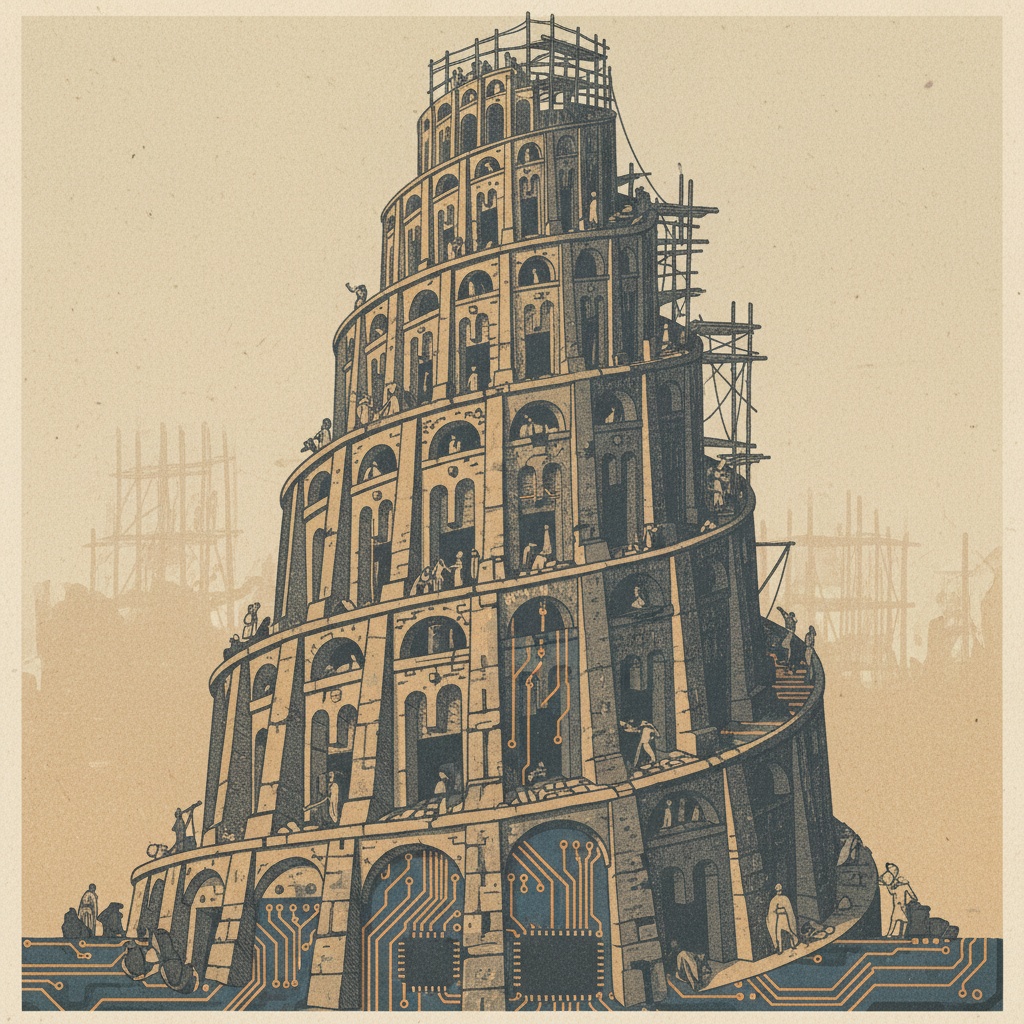
Paragraph 34 of the encyclical, as excerpted by the Criterion, contrasts a “Tower of Babel” with a “City of God”—one built on arrogance and self-sufficiency, the other on relationship and cooperation. Read cynically, that’s just biblical poetry. Read carefully, it’s an economic argument. The Tower of Babel is a project of centralized, self-justifying ambition. The City of God is distributed, relational, and accountable. The Silicon Valley that builds artificial general intelligence in secret, demoed on livestreams narrated by CEOs who speak of “raising the floor of human flourishing,” is the Tower version. The encyclical declines to name specific companies. It doesn’t need to.
What the Laptop Class Misses
Here is the thing that is going to grate on the knowledge economy’s nerves: the encyclical does not center the worries of the people who write about AI. It centers the people who do not write about AI but will live inside whatever architecture AI creates.
A contractor on a job site in Phoenix, the kind of person who wired the data centers that train foundation models, will not read Magnifica Humanitas. But his work is addressed by it. The document’s anthropology—that human dignity is found in creative participation, in the relationship between work and meaning—is a direct challenge to the logic that treats his trade as a cost to be eliminated. The encyclical is arguing that what gets automated is never just a task; it’s a person’s standing in a community. That’s a pre-modern idea, entirely out of step with the efficiency gospel preached in Mountain View and Menlo Park. It’s also, inconveniently, almost certainly correct.
One staff theologian seconded to the drafting group put it dryly, speaking in a hallway outside the Synod Hall before the press conference: “The document is trying to remind people that being human isn’t an engineering problem. The machine-learning frame treats it as one.” That will be heard, predictably, as an attack on technology. It’s better understood as an attack on the totalizing ambition of technology’s loudest evangelists.
Not a Pause, a Path
Nothing in Magnifica Humanitas calls for a “pause” on AI development or any ban on research—distinguishing it, sharply, from the open-letter circulars that circulate tech-twitter every six months. The document argues instead that the direction of technical development must be accountable to a moral telos, a purpose. That is a fundamentally different argument from “this is moving too fast.” Speed is not the issue; purpose is.
The date on the encyclical, May 15, was not chosen for proximity to any earnings release or funding announcement. It marks the 135th anniversary of Rerum Novarum, Leo XIII’s encyclical on capital and labor, which argued that workers have rights the market does not grant and cannot take away. That earlier document was controversial in 1891 among the comfortable because it refused to let economic relationships be the final word on human value. Magnifica Humanitas is making the same argument about the relationship between humans and machines in 2026. The tech industry spent the last decade acting as though the moral questions raised by automation were downstream of technical progress—to be solved later, or more precisely, to be solved by the same engineers who created them. The Vatican just argued, at length and with a straight face, that the moral questions are prior. That is a claim worth contending with, even if you do not share its theology.
Sources
- Presentation of Pope Leo XIV’s Encyclical Letter “Magnifica …
- Pope Leo XIV’s first encyclical Magnifica humanitas to be published May 25
- Pope Leo will publish first encyclical, ‘Magnifica Humanitas,’ on …
- Full Text of ‘Magnifica Humanitas’: Read Pope Leo XIV’s First …
- 13 things to know about Pope Leo’s encyclical on AI (May 25, 2026)