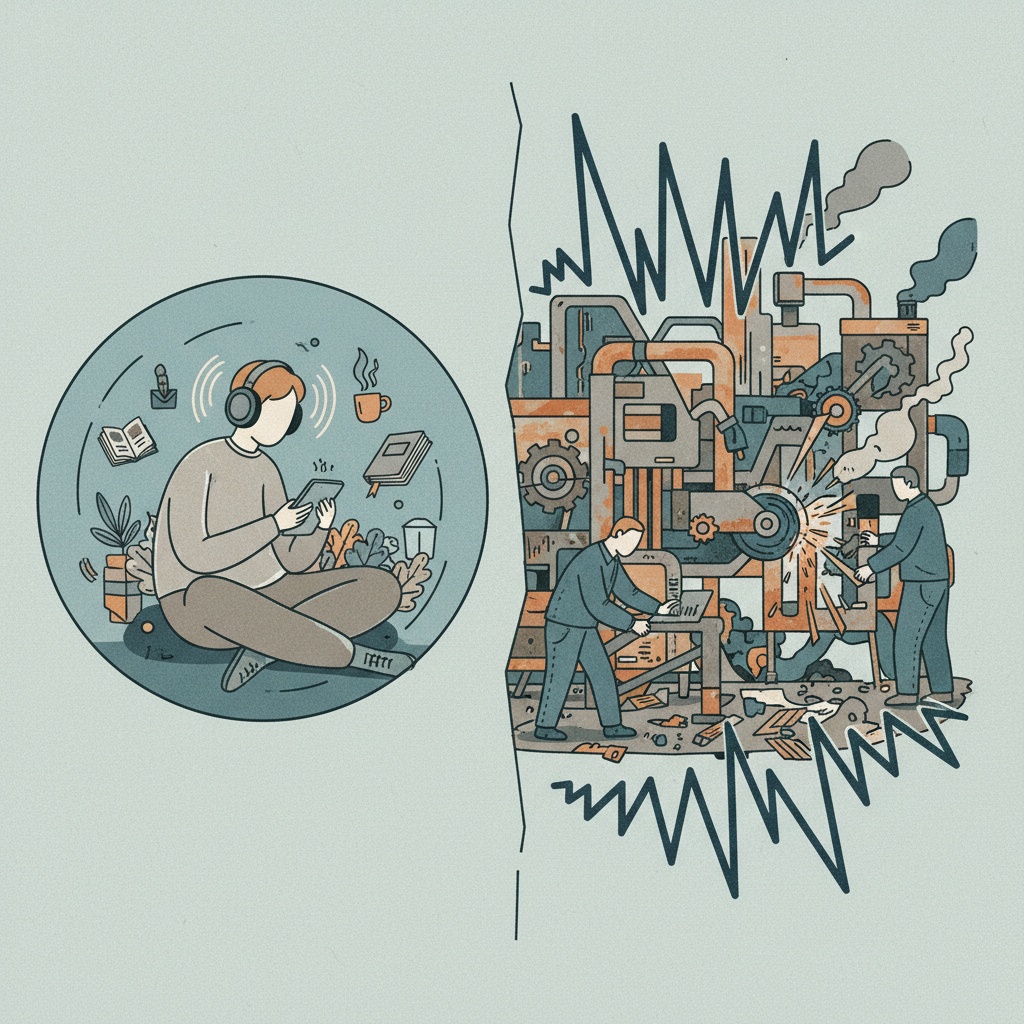
This week, an essay called “The AirPods Effect” went viral on Hacker News — 331 points, 593 comments, and presumably several thousand readers who nodded along while listening to something on their own earbuds. The thesis, as published in the Escape Newsletter, is that AirPods and their ilk are isolating us from one another, sealing each person inside a private audio bubble and eroding the casual interactions that once held communities together.
The essay is well-written. It is also, in one important sense, completely missing the point.
The problem isn’t that people are retreating into curated soundscapes. The problem is who gets to retreat — and who doesn’t.
The Luxury of Tuning Out
Noise-canceling earbuds are, at their core, a service that converts money into silence. The latest AirPods Pro 3, currently on sale at $199, offer adaptive audio that filters out construction noise, subway screech, and the open-plan-office chatter that knowledge workers love to complain about. The AirPods Max 2, at $509, go further. These are not trivial purchases.
But the people who most need silence are rarely the ones buying it. The night-shift worker in a loud warehouse doesn’t get noise cancellation. The home health aide in a cramped apartment with a blaring television doesn’t get spatial audio. The parent in a household where quiet is a luxury good doesn’t get to tap a stem and vanish into a podcast.
The “AirPods Effect” essay is, in effect, a meditation on the isolation of the professional class — written by a member of it, for an audience that shares its anxieties. It diagnoses a problem experienced by people who have the option to curate their sensory environment, and it mistakes that option for the problem itself.
The Noise That Earbuds Were Built to Escape
The real isolation isn’t happening inside the earbuds. It’s happening in the spaces that earbuds were designed to escape.
Consider the environments that have become louder and more intrusive over the past two decades. The open-plan office, which replaced cubicles and private offices in the name of collaboration, and which studies have consistently shown reduces face-to-face interaction rather than increasing it. The retail space with overhead speakers playing a branded playlist on a loop. The public transit car where half the passengers are watching videos on speakerphone. The digital-advertising ecosystem that turned every public surface into a screen.
These are not natural features of urban life. They are design choices — many of them made by the same technology industry whose members are now sharing essays about the isolating effects of consumer electronics. The irony is thick enough to cut.
A shift supervisor at a Memphis distribution center put it to me plainly: “You can’t block out the conveyor belts. The noise is the job.” He doesn’t own AirPods. He wouldn’t be allowed to wear them on the floor if he did. The isolation he experiences isn’t the curated kind — it’s the kind that comes from an eight-hour shift in an environment where casual conversation is physically impossible.
The Essay Economy
There is a genre of cultural criticism that has flourished in the newsletter era: the long-form diagnosis of a social ill, anchored to a specific consumer product, written in a tone of gentle lament. These essays are almost always aimed at the people who buy the product in question. They are acts of collective self-examination that rarely extend their gaze beyond the class that writes and reads them.
The Escape Newsletter’s essay is a perfectly good example of the form. But the form has a built-in limitation: it can only see the problems of the people who subscribe.
The 593 commenters on Hacker News debated the merits of the argument, the quality of the prose, the validity of the analogy. Very few, I suspect, asked whether they were the right people to be having the conversation at all.
The people who are actually isolated — by economic necessity, by the physical demands of their jobs, by environments they didn’t choose and can’t escape — do not get essays written about their headphones. They don’t get the luxury of a private audio bubble, and they don’t get the luxury of feeling guilty about it either.
The Real Intervention
If the goal is to reduce isolation, the intervention isn’t to shame people out of their earbuds. It’s to make the world less worth escaping from.
That means quieter public spaces. It means offices with walls. It means transit systems where the norm is headphones, not speakerphone. It means — and this is where the tech industry actually could help — designing products that reduce ambient noise pollution rather than just selling individuals the tools to block it out.
But those are boring, infrastructure-level problems. They don’t make for a viral newsletter essay. They require coordination, regulation, and long-term investment. They require acknowledging that the problem isn’t individual behavior but collective environment.
The “AirPods Effect” essay is a fine piece of writing. It’s also a symptom of the very condition it diagnoses: a culture so focused on individual consumption choices that it forgets to ask who built the world those choices are a response to.
Sources
- AirPods Ultra JUST LEAKED! - INSANE Cameras Built-in?!
- June 2026 kicks off with up to 25% in savings on current-gen AirPods: Pro 3, Max 2, more
- The AirPods Effect. How earbuds influence our beliefs and… - Medium
- AirPods: A new look for earphones - The Classic
- Apple is reportedly in the final stages of creating new AirPods with …