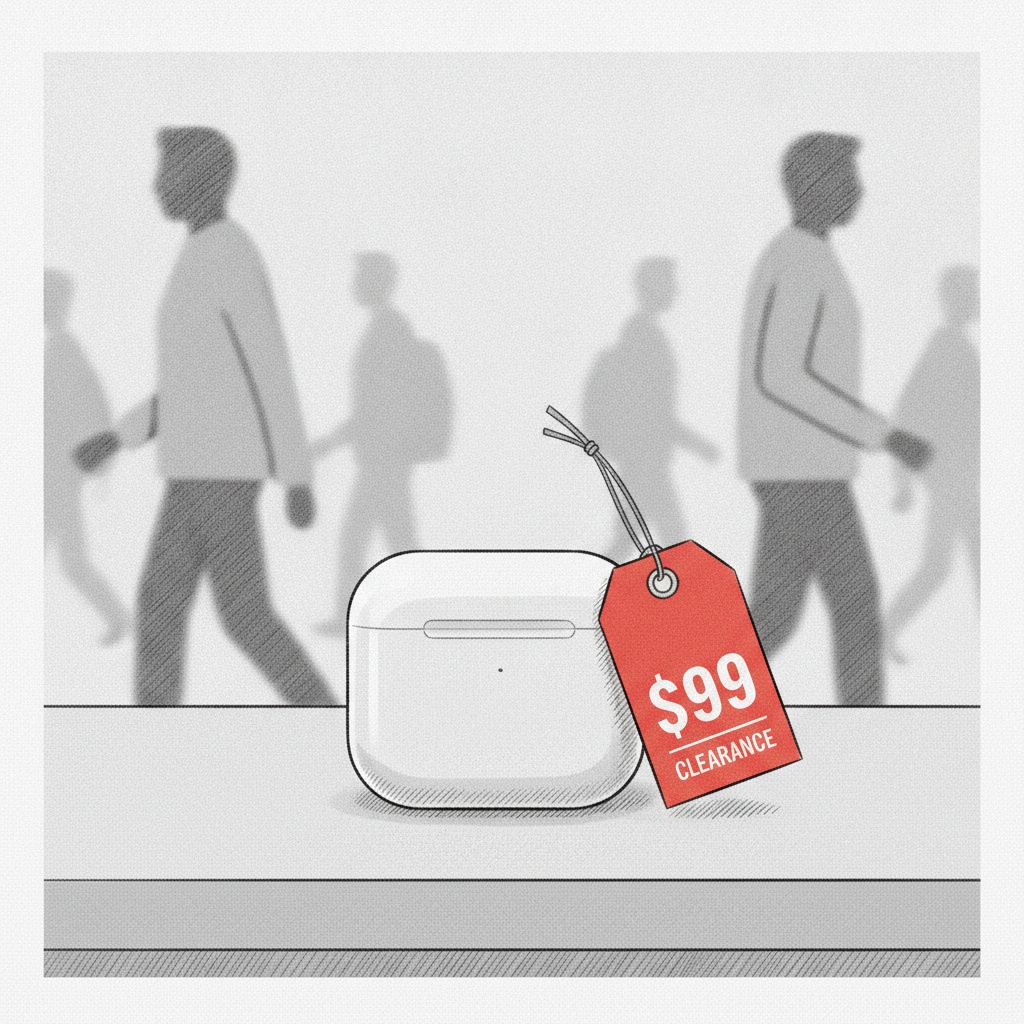
This week, Apple’s AirPods 4 hit $99 — an all-time low, quietly timed to land just before Father’s Day and the Prime Day pre-sale window. The AirPods Pro 3, the top-of-the-line model with active noise cancellation and AI-powered live translation, dropped to $179. These are not refurbished units or carrier-locked promotions. They are brand-new, shipping-today prices on Amazon, and they represent the moment Apple’s most culturally significant accessory crossed the psychological $100 threshold in the wrong direction for Apple and the right one for everyone else.
It is, as it happens, the same week a long essay titled “The AirPods Effect” is burning through Hacker News — 222 points, nearly 400 comments — arguing that wireless earbuds are reshaping our beliefs by isolating us from spontaneous human interaction. The essay, and the discussion around it, proceeds from a familiar premise: that there is something quietly corrosive about a generation walking through public space with silicone tips jammed into their ear canals, algorithmically severed from the possibility of overheard conversation, chance encounter, ambient community.
There is a real observation here. But it is also, unmistakably, a luxury observation.
The Price of Opting Out Has Collapsed
When AirPods launched in December 2016 at $159, they were a status symbol. The jokes about them were jokes about wealth — the “I dropped my AirPods” meme, the punchline being that someone owned a $160 pair of wireless earbuds in the first place. For years, the white stem protruding from an ear signaled something: enough disposable income to pay a premium for a frictionless Apple experience, enough confidence in one’s own taste to wear what was widely mocked on launch day.
At $99, that signal degrades to near-illegibility. The AirPods 4 are now priced like a nice dinner for two, like a tank of gas in California, like a single ticket to a mediocre concert. The barrier to entry has collapsed, and with it the idea that tuning out the world is a privilege of the well-off. What was once a luxury — the ability to curate your sonic environment in public — is now a commodity.
This is the part the cultural critics consistently miss. The “AirPods Effect” essay, and the genre it belongs to, is written by and for people who can afford to worry about the spiritual cost of convenience. The author, the commenters, the retweeters — they are not the people for whom $99 is a meaningful purchase decision. They are the people who bought AirPods at $159 or $249 and then felt ambivalent about them. The ambivalence is the product, and the product has a market: readers who want to be told their unease is wisdom.
What the Aisles at Walmart Tell You
Spend an afternoon at a big-box store in the suburban Midwest — not as a journalist on assignment, but as someone actually shopping for a Father’s Day gift — and the economics look different. A $99 pair of AirPods is not a philosophical statement. It is a gift that lands in the sweet spot between “I tried” and “I didn’t go into debt.” It is something a teenager can buy with a weekend’s pay from a summer job. It is, increasingly, the default — the thing you grab because the price has fallen far enough that not grabbing it feels like leaving money on the table.
One retail manager at a Columbus-area Target, restocking the electronics aisle between waves of last-minute shoppers, put it plainly: “At $99, these move. At $129, people think about it. At $159, they buy the off-brand.” He was not pondering whether his customers were making a choice about community versus isolation. He was watching inventory turn.
This is the actual AirPods effect: not a philosophical shift, but a price discovery. Apple has spent eight years driving the cost of wireless earbuds down the curve, and the market has responded exactly as markets do. More units sold. More ears plugged. More public silence. The cultural critics are documenting the outcome and attributing it to a change in values, when the engine is far simpler — price.
The Luxury of Worrying About Luxury
There is a long tradition of class anxiety masquerading as cultural criticism, and the discourse around AirPods fits it neatly. The Walkman was going to destroy social interaction. The iPod was going to create a generation of solipsists. The smartphone was going to end conversation. Each time, the critique was launched by people who owned the device and felt bad about it, and each time, the device became cheaper, more ubiquitous, and less interesting as a symbol.
The AirPods essay is the latest iteration of a genre that reliably confuses personal discomfort with social insight. The author notices that he feels isolated when he wears earbuds in public, and instead of taking them out, he writes 3,000 words about what it means that he doesn’t want to. The audience nods along, because they too own AirPods and feel a twinge of something when they pass a stranger in silence.
But the stranger at the bus stop wearing $99 AirPods 4 is not participating in this conversation. She is listening to a podcast, or a playlist, or nothing at all — just using the noise cancellation to carve out a pocket of quiet on a noisy commute. She is not making a statement about the decline of civic life. She is exercising a preference that $99 now buys her, and that preference is not the critic’s to interpret.
The Signal That Isn’t One
When the price of a good collapses, the good stops being a signal. That is the real story of AirPods in 2026: they have become infrastructure, not identity. The essayists can keep writing about what they mean, but the market has already moved on. At $99, AirPods mean about as much as a toaster — which is to say, they mean whatever the person using them wants them to mean, and nothing more.
The critics are not wrong that public space has grown quieter, more atomized, more individually curated. They are wrong that the cause is a cultural shift best addressed by essays. The cause is a price curve, and the price curve is indifferent to the essays. The cheapest AirPods ever made are now on sale for the cheapest price they have ever been listed at, and next year they will probably be cheaper. The silence will get louder. No amount of Hacker News commentary will change that.