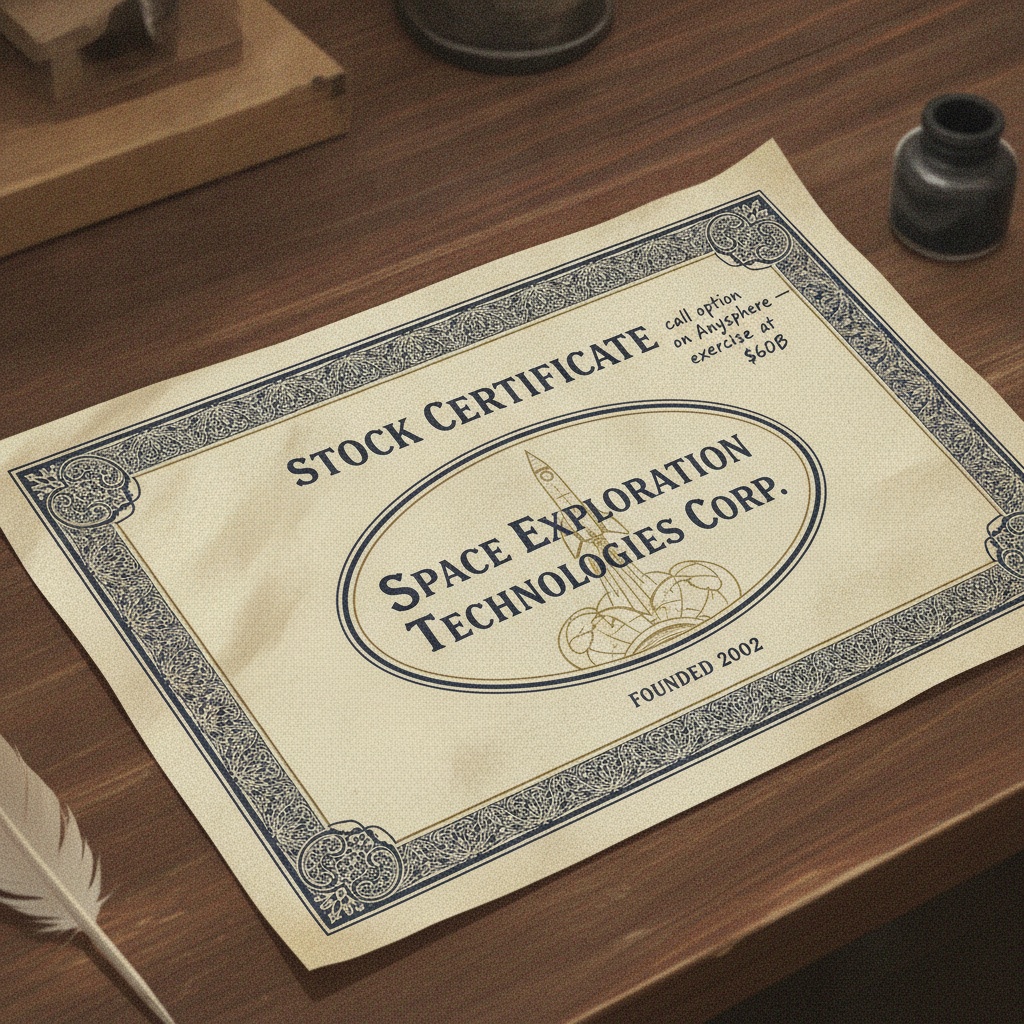
On Monday, SpaceX filed with the SEC that it would acquire Anysphere, the maker of the Cursor AI coding agent, for $60 billion in stock. The headlines wrote themselves: “SpaceX Bets Big on AI.” “Musk’s Empire Strikes Again.” The stock popped another 20%.
But the filing contained a detail that most of the coverage buried below the fold. SpaceX wasn’t making a spontaneous offer. It was exercising a pre-negotiated right — a binary choice structured months ago, before the IPO — to either pay Anysphere $10 billion for a commercial partnership or buy the whole company for $60 billion. The company picked door number two.
This is not an acquisition in the ordinary sense. It’s a call option that vested. And that distinction matters a great deal more than the sticker price.
The $60 Billion Price Tag Was Set Before the IPO, Not By It
The sequence is important here. SpaceX and Anysphere struck their initial agreement well before the June 12 IPO that valued the rocket company north of $2 trillion. At the time, SpaceX was still private, its shares were illiquid, and $60 billion in SpaceX stock was a number that existed mostly on a cap table, not a ticker.
Then the IPO happened. SpaceX raised $85 billion, the stock surged, and suddenly the paper SpaceX was offering Anysphere wasn’t paper anymore — it was the sixth most valuable equity on the planet. The $60 billion exercise price didn’t change. The underlying asset did.
That’s the part the breathless deal coverage skips. The $60 billion figure is being discussed as if SpaceX walked into a competitive auction and paid a market-clearing premium for a hot AI company. It didn’t. It had already locked in the price. What changed between November and June was SpaceX’s own valuation, not Anysphere’s negotiating leverage.
“It’s the oldest trade in the book,” one M&A lawyer told me in a courthouse hallway in Wilmington on Tuesday, waiting for an unrelated hearing to resume. “You write an option when the stock is cheap, wait for a liquidity event, and exercise when the math flips. The target gets a headline number. The buyer gets the company at a discount in real terms.”
She paused. “It’s just that nobody writes options on entire companies. Until now.”
The Real Innovation Isn’t AI — It’s the Deal Structure
Anysphere crossed $1 billion in annualized revenue last November, per its own disclosures. At $60 billion, that’s 60x trailing revenue — steep by any conventional metric, but not insane in the AI coding space, where GitHub Copilot and others have established that developer tools can compound revenue rapidly once they achieve seat penetration.
But the structure of the deal means SpaceX didn’t actually pay 60x. It paid with shares that, measured by the company’s pre-IPO valuation, were worth considerably less than the $60 billion the headlines trumpet. The dilution SpaceX shareholders are absorbing is real, but the effective cost — the value transferred from SpaceX to Anysphere’s investors — depends entirely on when you mark the currency.
This is a financial engineering trick, not a strategic masterstroke. And it’s one that more pre-IPO companies are going to attempt. The template is too elegant to ignore: identify a target in a hot adjacent space, negotiate a binary “partner or acquire” deal while your own shares are still private and illiquid, go public, and exercise once your currency re-rates.
Someone Should Have Asked About the Footnote
The SEC filing that CNBC linked on Tuesday is dry reading. But it raises a question that the coverage hasn’t grappled with: if SpaceX had this option all along, why wasn’t it disclosed more prominently in the IPO prospectus?
The S-1 from earlier this month certainly mentioned the Anysphere relationship. But the binary $10-billion-or-$60-billion structure — the fact that SpaceX had effectively written itself a call option on a $60 billion acquisition using pre-IPO stock as the strike currency — appears to have received less attention than the risk factors about launch anomalies and FAA licensing.
That’s not a scandal. It’s just revealing. The financial press spent the last six months dissecting SpaceX’s valuation, its launch cadence, its Starlink subscriber numbers, and its xAI merger. Almost nobody spent ink on the embedded optionality in a side deal that could — and now will — reshape the company’s enterprise AI strategy overnight.
What This Means for the Next Ten Pre-IPO Unicorns
The SpaceX-Anysphere deal will be studied. Not for its strategic logic — that part is straightforward: own the coding tool that your engineers and, eventually, your enterprise customers use. It will be studied for its structure.
Every venture-backed company approaching an IPO now has a new template: find a target whose valuation you can freeze while your own currency appreciates. Negotiate the option pre-IPO. Exercise post-pop. The headline number looks audacious; the effective cost is something closer to a pre-IPO collaboration budget that happened to vest into equity.
Anysphere’s investors are presumably satisfied. They’re getting $60 billion worth of SpaceX stock at a moment when the market can’t get enough of it. But they didn’t run a process. They didn’t solicit competitive bids from, say, Microsoft or Google. They accepted a structure that gave one buyer a binary right to acquire them at a pre-set price, and that buyer happened to be the one whose own stock was about to triple in a week.
“We took the deal that was on the table,” one Anysphere employee messaged a friend at a competitor on Tuesday, according to someone who saw the Slack exchange. “The number was big enough that nobody asked whether a different number could have been bigger.”
The column inches will keep coming. The valuation will be debated. The strategic merits will be litigated on earnings calls. But the real story of this deal — the one that will echo through the next decade of tech M&A — is that a pre-IPO company used its own illiquid equity to write a call option on an entire AI unicorn, and nobody noticed until the exercise notice hit the tape.
Sources
- SpaceX locks in $60 billion Cursor deal to close gap with rivals in AI coding race
- SpaceX Will Buy AI Coding Firm Cursor For $60 Billion - Forbes
- SpaceX to acquire Cursor for $60B in stock, days after blockbuster IPO
- SpaceX To Acquire Cursor Maker Anysphere in $60 Billion AI …
- SpaceX to buy AI coding startup Cursor for $60 billion - CNBC