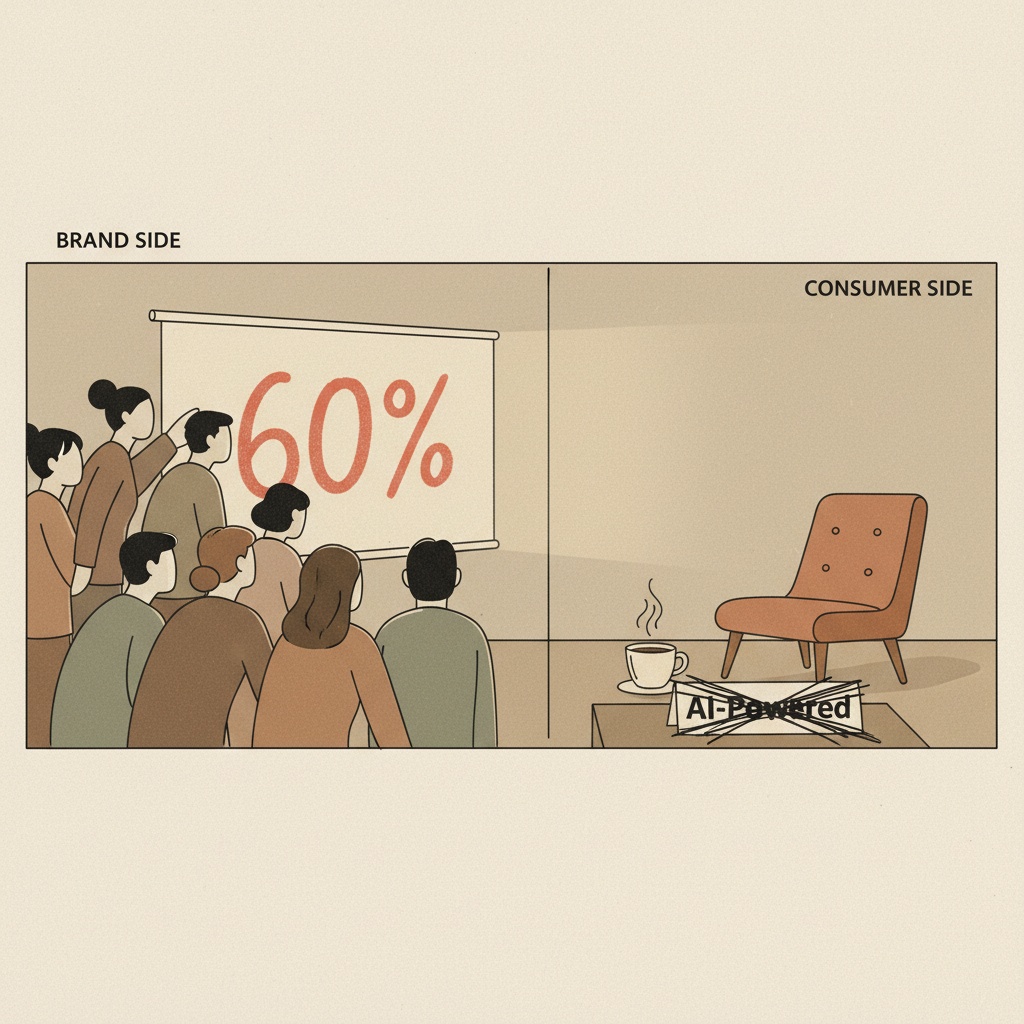
On Monday, WordPress VIP dropped a survey of 2,000 U.S. consumers that landed like a wet sandbag on every marketing team that’s spent the last eighteen months slapping “AI-powered” onto their product pages. Sixty percent of respondents said seeing ‘AI’ in a brand’s messaging is a turnoff. Eighty-six percent don’t fully trust AI-generated answers and still check original sources. The finding rocketed to the top of Hacker News and TechCrunch within hours.
The predictable take — already forming in the comments — is that this is a trust problem. Consumers have been burned by hallucinated answers, deepfakes, and chatbot customer service loops that lead nowhere. They’ve learned to treat AI claims the way they treat “all-natural” on a cereal box: as noise, possibly deception.
That reading isn’t wrong. But it misses the more interesting thing happening beneath the surface.
This isn’t a trust crisis. It’s a status crisis.
The Brand Signal That Became a Social Signal
Spend any time in the consumer internet and a pattern emerges. AI labels are concentrated disproportionately on products aimed at the mass market: budget travel aggregators, mid-tier CRM tools, essay-writing services, discount e-commerce, job-application automation. The kind of products that promise to save you time or money — and suggest, by their existence, that you might need the help.
At the premium end, the word barely appears. Apple’s marketing for its latest iPhone doesn’t mention Apple Intelligence on the front page of its website. Luxury fashion brands aren’t touting AI-designed collections even when they use generative tools internally. High-end consultancies describe their AI capabilities as “analytics” or “technology-enabled insights” — never as a chatbot.
What the WordPress VIP data captures, whether the respondents would articulate it this way or not, is that ‘AI’ has become a class marker. It signals cost-cutting. It signals automation in place of human attention. It signals that the product is for someone who doesn’t have the time, money, or connections to access the version with a person attached.
A marketing director at a mid-market SaaS company — reached via Slack DM during the survey’s media cycle — put it plainly: “Our A/B tests show the same thing. ‘AI’ converts with SMBs and students. Enterprise buyers click away. We’re running two sets of landing pages now, one with and one without, and the difference is a 22% conversion gap.”
That gap isn’t about trust. It’s about who you think your customer is.
The Verification Statistic Nobody Is Interrogating
Let’s return to the 86% figure — the share of consumers who say they don’t fully trust AI-generated answers and verify original sources. On its face, this reads as a rebuke to AI. But step back and ask: what was the baseline before AI?
Did consumers fully trust search engine results before 2023? Did they trust brand websites? Did they trust the packaging claims on the products they bought? The entire history of consumer behavior research says no. People have always been skeptical of what companies tell them. The difference now is that AI gives that skepticism a name and a target.
What’s actually new in the WordPress VIP data is the finding that 86% of people claim to verify sources. That number is almost certainly inflated by self-reporting bias — the same dynamic that makes 90% of drivers rate themselves above average. But the direction of the inflation is revealing. People want to be seen as the kind of person who checks sources, who doesn’t get fooled, who is too savvy for the algorithm. Saying you distrust AI is a way of saying you’re discerning.
This is the part the trust-crisis narrative gets backward. The survey respondents aren’t describing a failure of technology. They’re describing an identity they want to project.
What Brands Actually Do With This Information
The practical takeaway from the survey, for any company that sells to consumers, is not “stop using AI.” It’s “stop saying you’re using AI.” That’s already happening. The same brands that issued press releases in 2024 about their AI transformation are quietly scrubbing the term from consumer-facing copy in 2026. The technology stays. The label goes.
This is a familiar cycle. Organic food went through it. “Cloud” went through it. “Blockchain” went through it so fast the label was dead before the pilots were done. Every technology that starts as a differentiator ends as table stakes, and the transition point is always marked by a consumer backlash against the word, not the thing.
What’s different this time is the speed. The AI label is burning out roughly two years after ChatGPT hit the mainstream, which is about half the time it took “cloud” to become a marketing liability. The cycle is compressing.
For the brands that get this right, the move is obvious: talk about what the product does, not how it’s made. Nobody cares that their bank uses machine learning for fraud detection. They care that their money doesn’t get stolen. The AI label was always a proxy for a benefit the customer couldn’t feel — and that’s the actual lesson of the 60% figure. Not that consumers are afraid of AI. That they’re tired of being asked to care about something that doesn’t improve their lives in any way they can name.
A product manager at a consumer fintech company, standing outside a conference room in a San Francisco office building after her team reviewed the survey results, summed it up: “We spent six months building an AI feature. Now we’re spending six months figuring out how to describe it without using the word.”
That’s not a trust problem. That’s a marketing problem. And those are much easier to solve.
Sources
- Brands Race to Be Seen by AI. Consumers Race to Verify the Source
- When AI Gets Brand Information Wrong, Consumers Look Beyond the Brand
- TechCrunch on X: “Sixty percent of U.S. consumers say ‘AI’ in brand messaging is a turnoff, survey finds https://t.co/kysnqvF3AI” / X
- WordPress VIP: 60% of US Consumers Reject AI Brand Labels
- TechCrunch - WordPress VIP’s latest survey suggests…
- Sixty percent of US consumers say ‘AI’ in brand messaging is a turnoff, survey finds