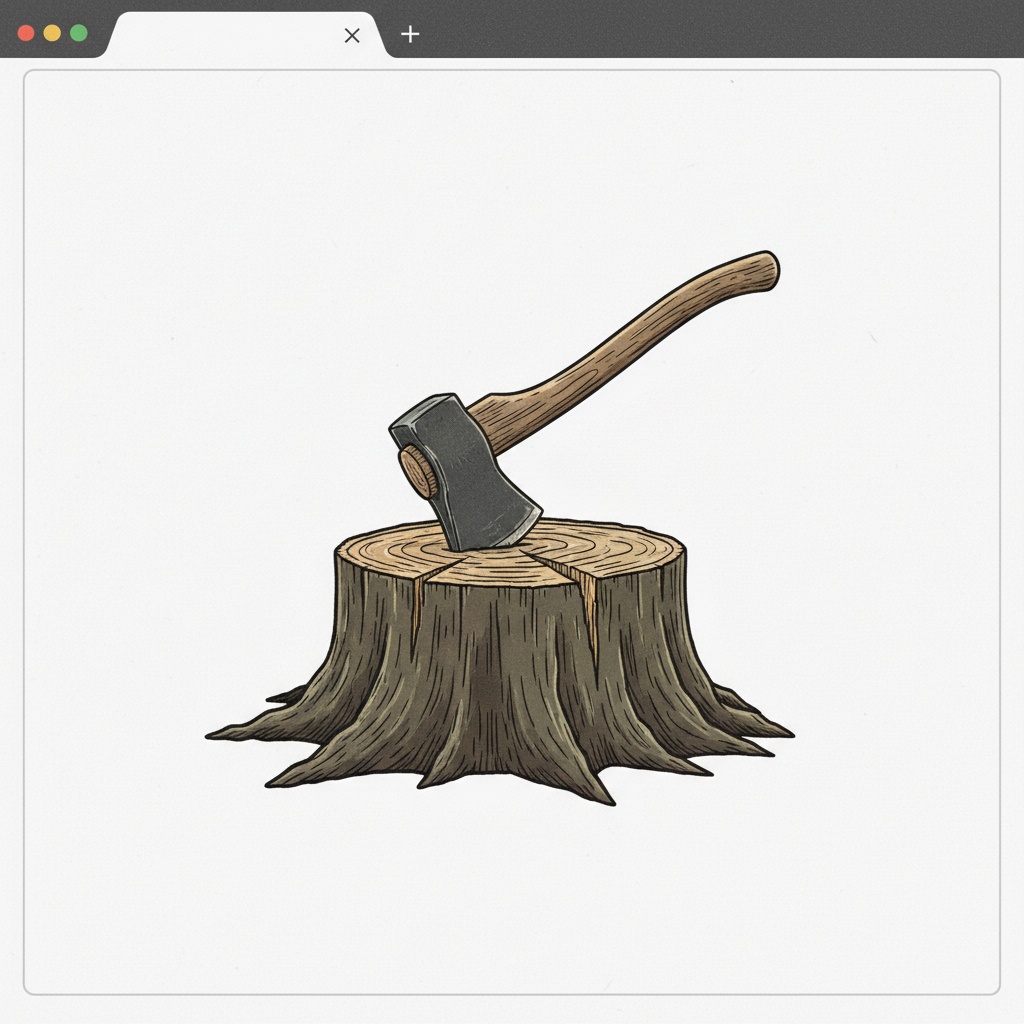
Sometime last week, a developer named Gavin Shapiro 3D-scanned his own splitting stump, his own maul, his own firewood, recorded the sounds of his own axe swings, and stitched the whole thing into a browser toy called Firewood Splitting Simulator. By Monday morning it sat at the top of Hacker News with 852 upvotes, and the internet briefly agreed on something: this is wonderful.
It is wonderful. The thunk is perfect. The wood splits exactly where you’d expect. There are no battle passes, no daily login bonuses, no in-app purchases for a sharper axe. You split wood. That’s it.
The commentary around it has followed a familiar script — a celebration of simplicity, a gentle rebuke to the bloated $70 titles that ship broken and patch later. One indie developer, one good idea, no publisher. The internet loves this story.
What it doesn’t love is the question that comes next: what happens on Tuesday?
The One-Time Cost of Delightful Software
Firewood Splitting Simulator is hosted at screen.toys, a domain that suggests a portfolio piece rather than a product. Shapiro built it, posted it, and moved on. There is no subscription tier. No analytics dashboard. No retention funnel meeting scheduled for Wednesday morning.
This is not a business model. And that is precisely why we’re talking about it.
The software economy has bifurcated into two modes. Mode one is venture-backed, growth-obsessed, and structured around extracting recurring revenue from users who are themselves the product. Mode two is the hobbyist’s gift economy — one-off projects built on nights and weekends, released for free, sustained by nothing but the creator’s dwindling enthusiasm and a day job that pays the rent.
There is almost nothing in the middle. The middle — sustainable, paid, single-purchase software made by small teams who earn enough to keep making it — has been hollowed out. Apple’s 30% cut, the death of paid-up-front mobile apps, the expectation that software is either free or a subscription, and the brutal unit economics of charging $5 once for something that costs thousands in labor to build: each of these has taken a swing at the midsection.
Shapiro’s simulator landed because it’s good. But it landed as a surprise because the infrastructure that would let it be anything more than a surprise — a storefront where small paid software isn’t buried, a payment model that doesn’t demand recurring billing, a customer base trained to pay for tools rather than rent them — no longer meaningfully exists.
The Subscription Mill Doesn’t Want Your Axe
“The thing nobody says out loud,” one mobile developer told me in a Slack DM during the simulator’s HN run, “is that I could build something like this in a weekend. I don’t, because I have to ship three A/B tests by Friday or my retention number dips and the quarterly review gets awkward.”
This is the actual constraint. Not talent. Not tools. The constraint is that the market has organized itself around a set of incentives that make one-off paid software an act of charity rather than a career path.
Consider the numbers. The median iOS app earns less than $1,000 per month. The subscription-model apps that do earn are heavily concentrated in a handful of categories — fitness, meditation, dating, productivity. A $3.99 axe-splitting simulator with no recurring hook doesn’t just compete with free; it competes with an entire ecosystem that has trained users to expect indefinite updates for nothing.
So the people who can build Firewood Splitting Simulator — skilled developers with an eye for craft — don’t. They work at Stripe or Figma or some mid-tier SaaS company, and they ship their delightful, single-purpose projects as portfolio pieces on weekends, if they ship them at all. The ones who do ship them for free get a Hacker News spike and a few thousand Threads shares. Then the moment passes, and the economics reassert themselves.
What the Viral Hit Actually Measures
The simulator’s 852 upvotes are not a signal of demand. They are a signal of deprivation. People are upvoting a reminder of what software felt like before the subscription mill ate everything — small, finished, satisfying, yours. The intensity of the response is proportional to the scarcity of the thing being responded to.
This is not a market failure in the regulatory sense. No antitrust suit will fix it. No policy intervention will make paid-up-front software viable again. The forces that hollowed out the middle — platform rent-seeking, consumer expectations shaped by a decade of free-to-play, the brutal math of customer acquisition costs — are structural. They are the natural outcome of markets optimizing for extraction over craft.
But it is worth noticing what we lose when the middle disappears. We lose the person who could build three of these a year and live on it. We lose the version of the simulator that gets better over time because someone’s paying the rent with it. We lose the ecosystem of small, weird, paid software that used to exist when shareware was a viable path and “try before you buy” wasn’t a funnel into a $9.99 monthly charge.
Shapiro built something good. The internet noticed. By next week, the internet will have moved on to something else. The simulator will still be there, unchanged, unfunded, a perfect little artifact of a mode of software creation that the market has decided it doesn’t want to pay for — even as it applauds wildly every time one slips through.