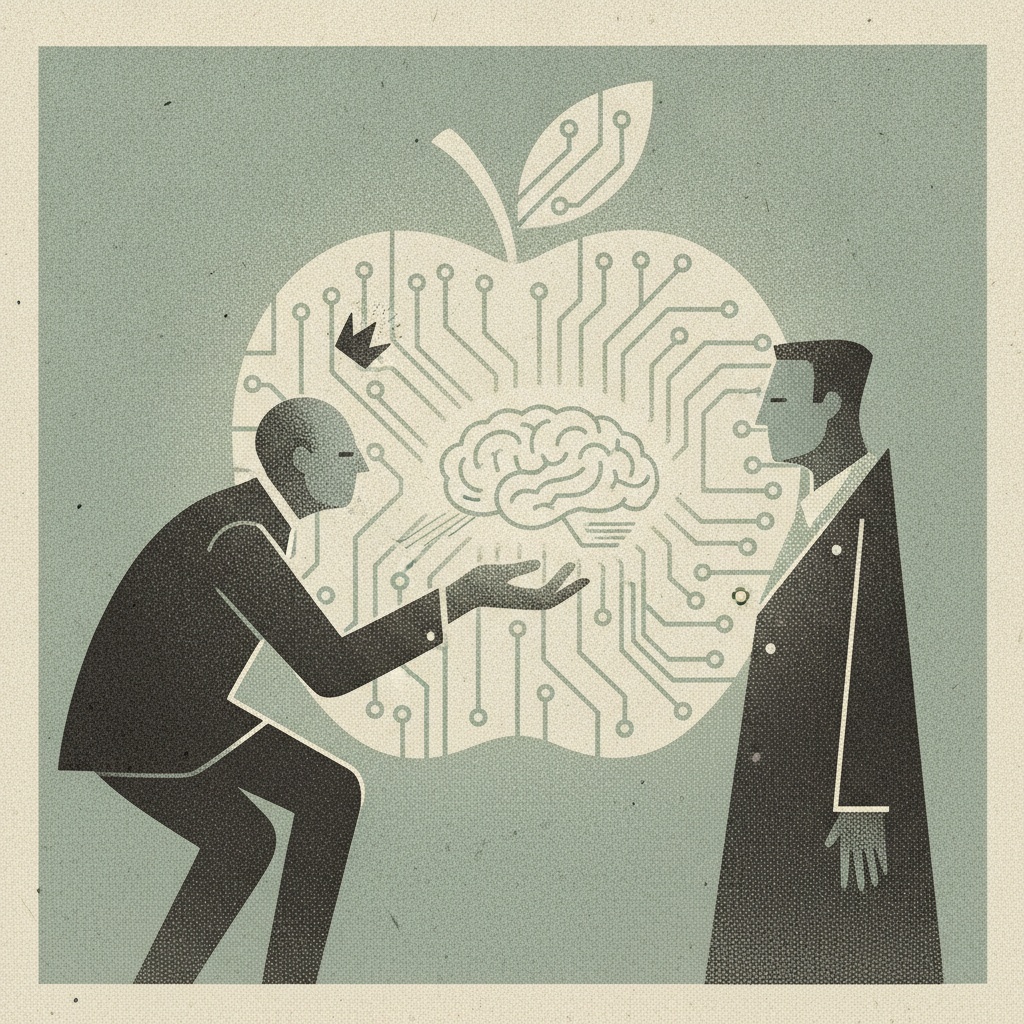
On Monday, June 8, 2026, Tim Cook took the stage at Apple Park for what is widely expected to be his final WWDC keynote before stepping down. Two years and one day after Apple first unveiled Apple Intelligence to a skeptical audience — and two years of missed deadlines, internal rebuilds, and rivals running up the score — the company finally showed the Siri overhaul it had promised. Siri AI is real. It ships this fall with iOS 27.
The applause in the room was genuine. The coverage, however, has already settled into a familiar groove: Apple was late, Apple is catching up, and the real question is whether Siri AI closes the gap with Google’s Gemini or OpenAI’s latest model. This is the right question for product reviewers. It is the wrong question for everyone else.
The story worth telling isn’t about the product. It’s about the calendar. Apple’s AI strategy only got unstuck when the man who built the company’s most successful decade was no longer the man deciding when it was ready.
The Roadblock Wasn’t Technical
Apple’s AI problems were never really about engineering. The company has shipped custom silicon that rivals Nvidia’s mobile offerings, built on-device ML that works offline, and recruited aggressively from the same talent pools its competitors fish in. When Craig Federighi and John Giannandrea did a press tour earlier this spring explaining that Siri was being “rebuilt from scratch,” the subtext was not that Apple couldn’t build it. It was that Apple wouldn’t ship it until someone decided it met the bar.
That someone was Tim Cook. And for two years, his bar was higher than anyone else’s — including, apparently, his own team’s best estimates. The original Apple Intelligence rollout was pitched at WWDC 2024 as arriving “over the next year.” It arrived two years later. That kind of delay doesn’t happen because of a bug. It happens because the person at the top vetoed every interim version as not good enough.
There is a version of this story where that patience is a virtue. Apple has built its brand on polish, and shipping a half-baked AI assistant that hallucinates calendar invites or misreads texts would be genuinely damaging. But there is another version, and it’s the one that explains why Monday’s keynote felt less like a triumph than a relief.
The CEO as Bottleneck
Cook’s Apple is a supply-chain masterpiece and a product-culture paradox. The same man who can negotiate a multi-year titanium supply agreement and navigate trade wars with Beijing is also the man who, by multiple accounts, personally signed off on every significant AI feature delay. A former senior engineer who left Apple’s Siri group in late 2025 told me in a Signal exchange after the keynote: “We had demos that worked 18 months ago. The problem was never the tech. The problem was that every demo had to survive a meeting where one person could say ‘I don’t love it’ and kill the timeline.”
The quote matters because it captures something the conventional Apple narrative misses. We talk about Apple as an institution — its culture, its values, its obsessive craftsmanship. But institutions are just people, and at Apple, for a very long time, one person’s instincts have been the final word on what ships and when. When that instinct was applied to industrial design, it gave us the unibody MacBook. Applied to a fast-moving field where competitors iterate publicly and improve in production, it gave us a two-year AI delay while OpenAI and Google shipped, learned, and shipped again.
The Succession Premium
Here’s what I think actually changed between WWDC 2024 and WWDC 2026: Cook decided to leave. Once the transition plan became real — once the board started discussing succession in earnest and Cook began thinking about legacy rather than quarterly execution — the calculus shifted. A delayed Siri was no longer just a product miss. It was going to be the headline on his departure.
We saw something similar at Microsoft when Steve Ballmer’s retirement was announced and suddenly the company pivoted hard toward cloud, killed the Nokia acquisition, and began the cultural overhaul that Satya Nadella would later accelerate. The lame-duck period isn’t a liability; it’s a release valve. Decisions that were too risky when the CEO was defending a reign suddenly become possible when the CEO is defending a legacy.
Anyone who has worked in a large organization recognizes this dynamic. The person who says no to everything becomes, in their final months, the person who wants at least one big yes on the board. That’s not cynicism. It’s institutional physics.
The Question No One Asked at the Keynote
The obvious question about Siri AI is whether it’s any good. The more interesting question is why Apple waited until the CEO’s exit to ship it. If the answer is that the technology simply wasn’t ready — despite an engineering team that believed otherwise — then Apple has a decision-making problem that no amount of neural-engine silicon can fix.
If the answer is that the technology was ready, but the institutional structure concentrated veto power in a single role, then what Apple really showed at WWDC 2026 wasn’t a new AI assistant. It was a preview of what the company looks like when the next person gets to decide what’s good enough.
Sources
- Siri AI, Apple Intelligence, iOS 27: Everything You Missed …
- Apple Targets Spring 2026 for Release of Delayed Siri AI Upgrade
- Apple bets on overdue Siri fix to close AI gap - Reuters
- Apple WWDC 2026 as it happened: Siri AI, iOS 27, macOS Golden …
- WWDC 2026: Everything announced on Siri AI, iOS 27, Apple …
- Apple WWDC 2026 June 8: Introducing Siri AI and more - YouTube