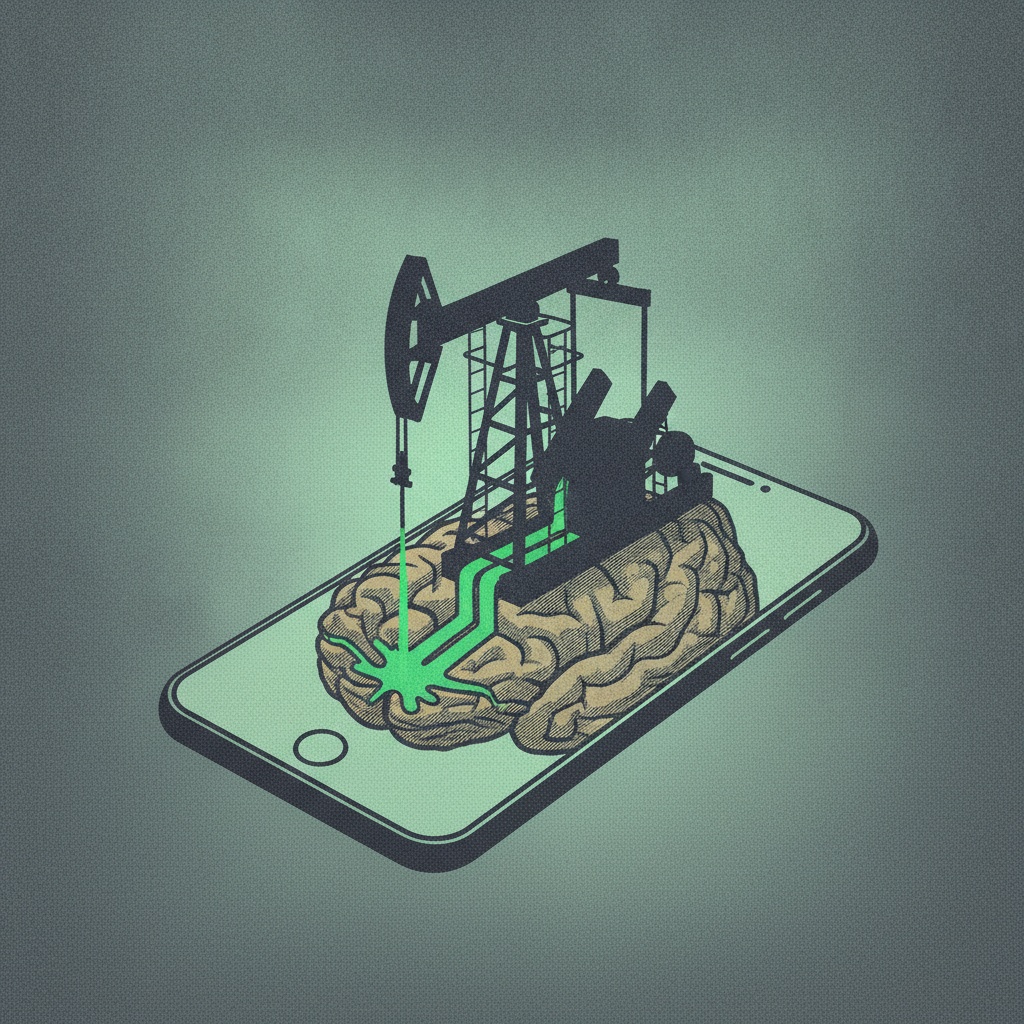
On Friday evening, a blog post titled “Dopamine Fracking” — published nearly two months ago by a programmer writing under the handle “igerman” — shot to the top of Hacker News, where it sat at 597 points and 300 comments by Saturday morning. The essay coins a term for something you have definitely felt: the process by which a complex, rewarding activity gets strip-mined for its most concentrated pleasure hit, leaving the original thing hollowed out and the participant craving more.
The examples are vivid and true. A strategy game, once enjoyed for its depth, gets optimized into a spreadsheet of build orders and tier lists. A hiking trail becomes a backdrop for Instagram geotags. A conversation becomes a chance to deploy a viral reply-guy quip. The metaphor — hydraulic fracturing applied to the brain’s reward system — lands because it names something millions of people experience daily without having the language for it.
It is also, and this is the part nobody wants to say out loud, a perfect specimen of the thing it diagnoses.
The Viral Diagnosis Is the Disease
The essay’s success follows a formula as predictable as the engagement-bait it critiques. A clever, sticky neologism. A metaphor drawn from an industrial process the reader vaguely disapproves of. A catalog of examples that flatter the reader’s sense that they, unlike the masses, see through the game. A tone of weary recognition that signals membership in a discerning minority.
This genre — the tech-skeptic concept essay — now has its own established pipeline. The writer observes a draining pattern in digital life, names it with a punchy compound noun, illustrates it with anecdotes, and publishes. Readers encounter it on an aggregator optimized for exactly this kind of high-concept, in-group-affirming content. They upvote. They comment. They feel the quiet satisfaction of having their unease ratified by a stranger with a good metaphor. They share it. And then, within 48 hours, they need the next one.
“Dopamine fracking” is a brilliant diagnosis. But reading it, sharing it, and feeling clever about having read it — that is not resistance. It is consumption of the same reward pathway the essay describes, repackaged for people whose identity requires them to believe they are above such things.
The Numbers Don’t Care About Your Self-Awareness
This is not a moral failing. It is a structural one. The essay’s distribution mechanism — Hacker News, Reddit, Twitter — optimizes for exactly the spike of recognition the essay provides. The 597 upvotes are not a measure of the essay’s truth value. They are a measure of how efficiently it triggered the “yes, that’s exactly it” reflex in the HN demographic.
Think about what happened to the readers. They read 3,000 words about how extractive feedback loops cheapen experience. They felt a jolt of validation. They scrolled to the comments to see if others felt it too. Some wrote a paragraph of their own, extending the metaphor, getting their own smaller hit from each reply and upvote. The entire cycle — diagnosis, distribution, consumption, performance — is indistinguishable from the thing being diagnosed.
One engineer I spoke with in a Slack channel for a midsize SaaS company put it bluntly: “I sent the dopamine fracking essay to six people. Then I checked if any of them had replied. Twice.” He paused. “I’m not even sure I disagreed with the essay’s point.”
The People Who Need the Lecture Won’t Read It
The essay’s most uncomfortable blind spot is its audience. The people who most need to hear that they are hollowing out their own attention are not reading 3,000-word blog posts on a Saturday morning. They are watching algorithmically served short-form video, or refreshing a sports-betting app, or grinding through a battle pass in a game they stopped enjoying six months ago.
The audience that actually reads “Dopamine Fracking” is a self-selected group that already believes it. The essay does not persuade. It confirms. It gives people who have already opted out of the worst of the extraction economy a vocabulary for their choices — and, crucially, a small hit of superiority while they acquire it.
This is not a criticism of the essay’s quality. It is genuinely well-written. The metaphor is apt. The problem it describes is real. But the genre it belongs to has become a consumable good, not a lever. Naming a problem is not the same as solving it. Sharing a diagnosis is not the same as treating it. And feeling seen by a blog post is not the same as changing your behavior.
Where Does This Leave Us?
If the essay is right — and I think, on the facts, it mostly is — then the only coherent response is to stop treating recognition as action. The internet will keep fracking your attention whether or not you have a clever name for the process. The test of whether you understood the essay is not whether you bookmarked it or sent it to a friend. It is whether you closed the tab and did something that offers no immediate, concentrated reward.
Go for a walk without your phone. Read a book that is boring for the first hundred pages. Play a game on its default difficulty without consulting a wiki. Cook something from a recipe you have to read twice. These are not radical acts. They are not acts of resistance. They are just the ordinary texture of a life that has not been optimized for extraction — and they are available to anyone who stops waiting for the next essay to explain why they feel drained.
The term “dopamine fracking” will now enter the lexicon. It will be cited in Substack posts and podcast intros and LinkedIn thought-leadership for the next eighteen months. It will be applied, increasingly loosely, to everything from dating apps to airport lounges. And it will, in the process, become exactly the kind of extractive shorthand it was coined to warn us about.
Perhaps the author saw this coming. The blog post’s closing line is, after all, self-deprecating about the whole enterprise. But self-deprecation is its own kind of fracking — a way to extract the pleasure of having been clever without bearing the weight of having meant it.
You already know this. That’s the uncomfortable part. You knew it before you read the essay. You knew it before you read this column. The question is what you do after you close the tab.