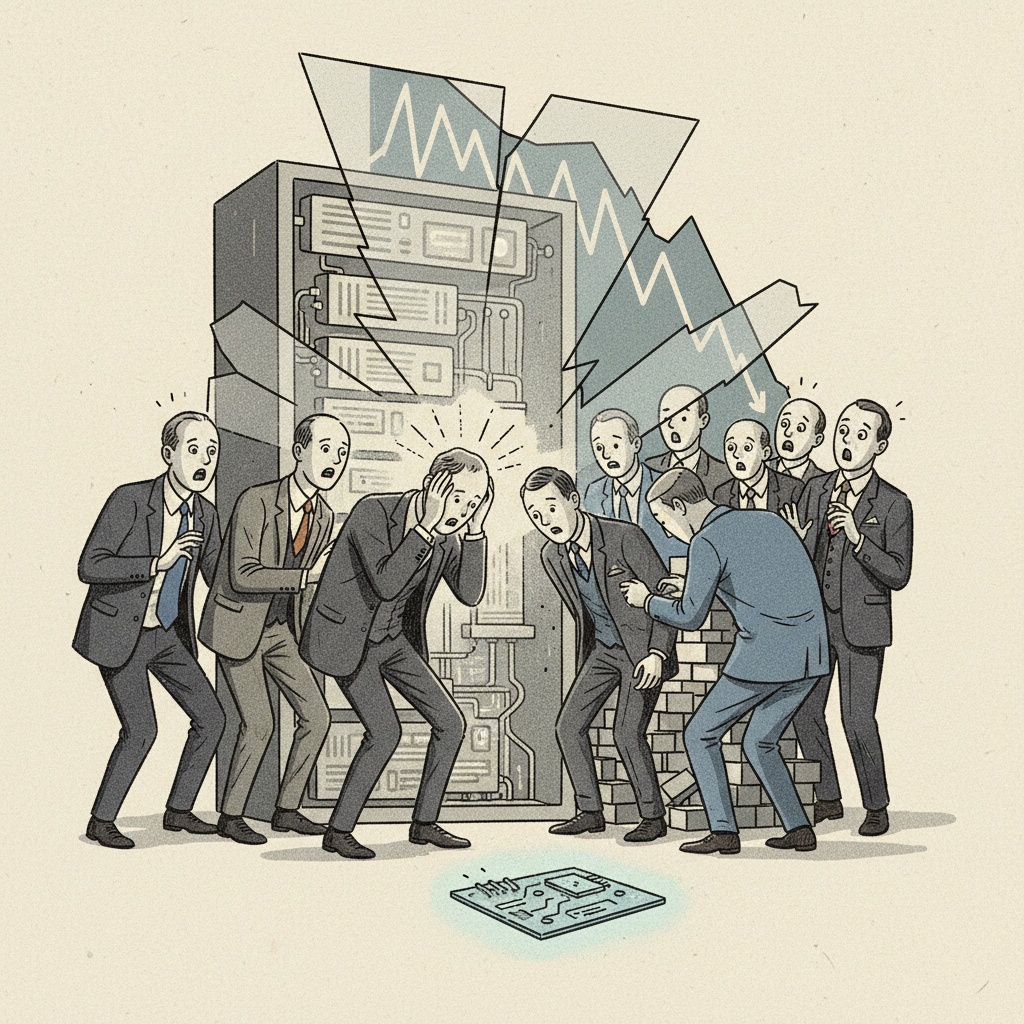
The Hacker News thread that racked up 560 upvotes and nearly a thousand comments this week is ostensibly a confessional — a collective inventory of the moment each poster realized generative AI wasn’t a toy. A developer describes watching Claude refactor a thousand-line codebase in twelve seconds. A translator recounts seeing a client replace her with a fine-tuned model that costs $47 a month. A designer posts a screenshot of a Figma competitor that generated thirty layout variations during the time it took him to pour a coffee.
The thread has the texture of a support group. But read past the first hundred comments and a pattern emerges that nobody in the thread names directly: nearly every “oh shit” story is told by someone whose economic position depends on other people not having access to the same capability. The translator wasn’t stunned by AI’s fluency — she was stunned that her client could now get adequate translation without paying her professional rate. The developer’s awe curdles into anxiety at the precise moment he realizes the tool doesn’t augment his billing rate; it compresses it.
This isn’t a failure of self-awareness unique to the HN crowd. It’s a structural feature of how knowledge workers have processed automation for thirty years. The bargain was always: we’ll automate the factory floor and the call center and the back office, but my expertise is judgment, creativity, taste — the stuff that can’t be parameterized. What this week’s thread captures, however unintentionally, is the collapse of that distinction.
The February Coordination Order That Nobody’s Talking About
While engineers trade war stories on HN, the California Superior Court of San Francisco County has been quietly building the legal scaffolding that will determine whether any of this matters. In February 2026, the court entered a coordination order consolidating twelve separate product-liability cases against OpenAI into a single proceeding. The central question is deceptively simple: is a chatbot a product, or is it a service?
Character Technologies already lost on this point. The court ruled that a chatbot constitutes a product for liability purposes when the allegations target specific design features rather than the provider’s ongoing conduct. That distinction sounds technical. It isn’t. If large language models are products, the companies that build them can be sued the way Ford gets sued for a defective brake system — strict liability, no need to prove negligence. If they’re services, the liability regime looks closer to what a consulting firm faces for giving bad advice: hard to prove, easy to disclaim.
The coordination order means these twelve cases won’t be litigated in twelve different postures. It means the plaintiffs’ bar has a unified front. And it means the answer — product or service — will be determined not by a blog post or a white paper or a Sam Altman tweet, but by a judge in San Francisco.
“The model companies spent three years telling Washington they needed light-touch regulation because nobody could predict where the technology would go,” one attorney involved in the coordination told me, standing in the courthouse hallway after the February hearing. “Now they’re going to argue in front of a judge that a chatbot isn’t a product. Good luck with that after you’ve spent 24 months calling it the most important product in human history.”
The Hidden Stake: Who Gets to Be the Customer
Back to that HN thread. The responses cluster around two poles: wonder and dread. But neither pole engages with the actual structural change underway. Generative AI isn’t just making knowledge workers more productive — it’s changing who qualifies as a customer in the first place.
An enterprise that previously needed three front-end engineers, two designers, and a UX researcher to ship a feature can now ship something that’s 80% as good with one senior engineer and a suite of AI tools. The remaining engineer keeps a job. The other five don’t. But from the company’s perspective, the calculus is straightforward: AI didn’t replace the engineers; it replaced the need for engineers.
This is the part of the story that the HN thread dances around. The anxiety isn’t that the machines are coming for elite knowledge work. It’s that the machines are coming for the market that elite knowledge work depends on — the layer of customers who can now solve their problems without hiring anyone at all.
A small-business owner in suburban Ohio who used to pay a local web developer $12,000 for an e-commerce site can now prompt a tool to build one in an afternoon. That’s $12,000 the developer will never see — not because the tool took the developer’s job, but because the customer stopped being a customer.
The Consensus That Doesn’t Survive Contact with a Balance Sheet
The predictable right-of-center response to all this is cheerful: creative destruction, Schumpeter’s gale, the same forces that eliminated lamplighters and switchboard operators will generate new categories of work we can’t yet imagine. It’s the view from a portfolio that’s doing fine and a mortgage that’s already paid off.
What that view misses is the speed differential. Lamplighters had decades to retrain. The typist pool didn’t vanish the month WordPerfect shipped. The trough between the introduction of a transformative tool and the emergence of new jobs that require it as infrastructure was historically measured in years, sometimes decades. The generative models shipping today are improving fast enough that the trough may be measured in quarters.
That doesn’t mean the optimists are wrong about the long run. It means the long run is being asked to do political and social work it was never designed to do. “In the long run we’re all dead” wasn’t Keynes being morbid; it was Keynes pointing out that long-run models are useless for people who have to pay rent this year.
The February coordination order in San Francisco, not the HN thread, is the signal worth watching. If chatbots are products, the liability costs of deployment go up — which slows the speed differential. If they’re services, the liability costs stay low — which means the replacement rate stays high. Either way, the people posting in that thread about their “oh shit” moments aren’t wrong to be anxious. They’re just anxious about the wrong thing. The threat isn’t that AI will do their job. It’s that it will do their customers’ jobs — and the customers won’t need them anymore.
The Real ‘Oh Shit’ Moment Is Still Coming
The HN thread is a useful artifact of a profession discovering that its monopoly on technical capability is eroding. But the thread’s emotional register — part awe, part dread, part nostalgic techno-optimism — obscures a harder truth. None of the people posting have had their real “oh shit” moment yet.
That moment arrives when the tools are good enough that the clients stop calling, not because they found cheaper engineers, but because they stopped being people who need engineers at all. When that happens — and the February coordination order suggests the legal system is already preparing for it — the debate won’t be about whether AI counts as “real” engineering or whether prompt-writers deserve the title of developer.
The debate will be about who still has a claim on the economy’s value, and why. The HN thread is a premonition. The court orders are the calendar.
Sources
- Ask HN: What was your “oh shit” moment with GenAI? - Threads
- Ask HN: What was your “oh shit” moment with GenAI? - Threads
- Ask HN: What was your “oh shit” moment with GenAI? - Hacker News
- California Court Decision on AI Products Liability Litigation
- AI Copyright Lawsuits for Authors & Publishers (2026 Tracker)
- The New AI Regulations That Will Impact Your Legal Team | Ironclad