On Tuesday, May 26, the Federal Reserve Bank of San Francisco published a research brief asking whether the United States has entered a new era of high productivity growth. The answer, after a meticulous tour through the data, was essentially: not yet. Productivity growth since 2019 has averaged 1.6% annually — better than the anemic 1.2% of the 2010s, but a rounding error away from the 1.5% seen from 2004 to 2019. The AI revolution, the brief concluded, “has not, as of early 2026, translated into economy-wide productivity acceleration.”
This landed in the same week that a Hacker News thread titled “What was your ‘oh shit’ moment with GenAI?” pulled in over a thousand comments from engineers, designers, and researchers recounting the exact instant they realized the tools were transformative. One described watching an AI refactor a week’s worth of code in forty-five seconds. Another talked about generating a working grant proposal during a lunch break. The anecdotes are vivid, personal, and entirely sincere.
Both things are true. That is the puzzle.
The Gap Between Your Spreadsheet and the National Accounts
The LSE study that Fortune cited last month quantified what many knowledge workers already feel: AI users save roughly the equivalent of one workday per week. A survey by METR, the AI evaluation nonprofit, found that technical workers would demand a median of $20,000 in additional annual compensation to voluntarily give up their AI tools for a month — a revealed-preference measure that suggests the tools are genuinely valuable, not just hyped.
But if millions of workers are suddenly 20% more productive, why isn’t it showing up in output-per-hour statistics? The San Francisco Fed economists ran through the candidate explanations. Maybe AI benefits are concentrated in sectors where output is hard to measure — healthcare, education, professional services. Maybe the gains are real but too small in aggregate to move the needle against the broader slowdown in manufacturing and construction productivity. Maybe adoption is still too narrow; the brief notes that only about 12% of businesses reported using AI in production processes as of late 2025.
All plausible. All unsatisfying.
Here’s another possibility the brief doesn’t explore because it’s not the kind of thing central bank economists measure: the gains are being consumed by the organization itself.
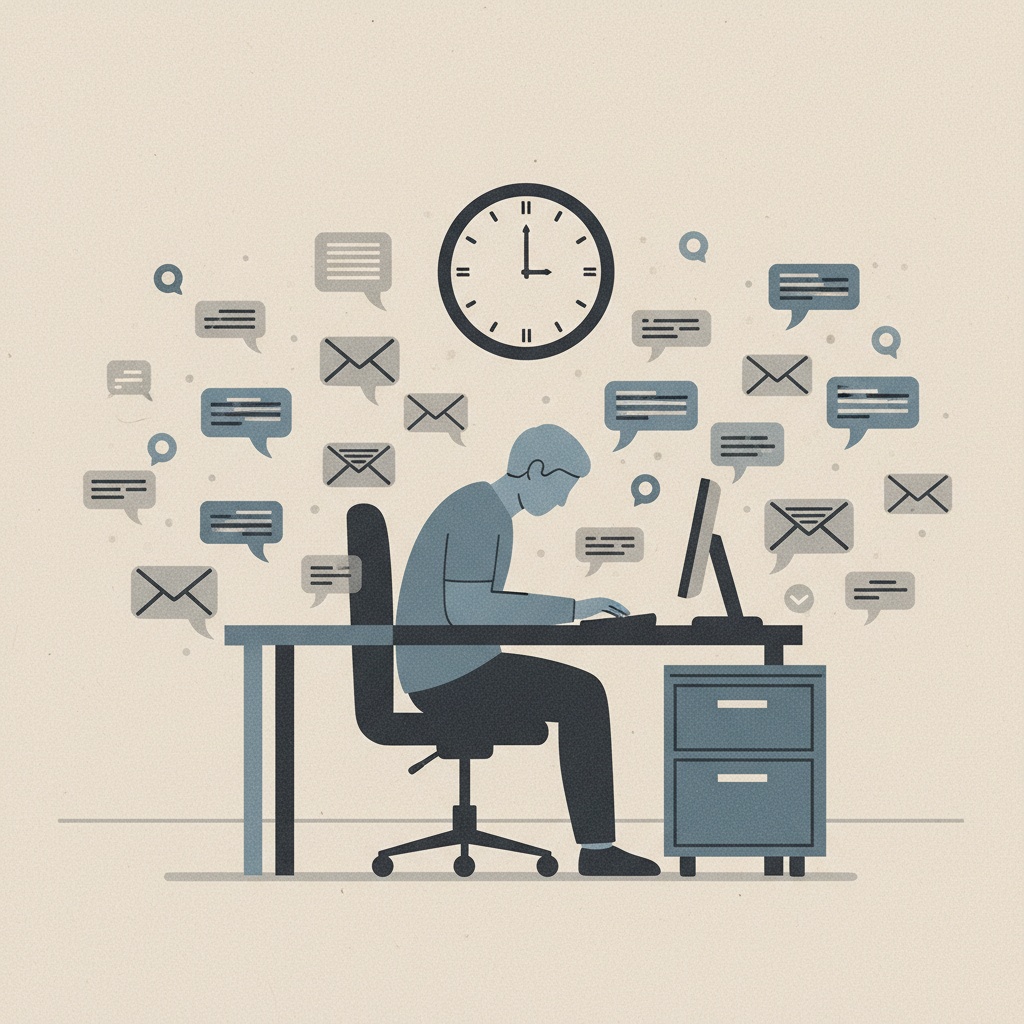
Slack Messages Are Eating Your Time Savings
Talk to anyone who’s had their “oh shit” moment with these tools, and they’ll describe a very specific kind of productivity boost: the ability to produce a thing — code, text, analysis, a slide deck — dramatically faster than before. What they rarely mention is what happens to that thing after they ship it.
It goes into review. A manager who’s now using AI to generate feedback on AI-generated work adds three rounds of comments. A compliance team, equally tooled-up, flags edge cases that a human would have let slide because a human understands materiality. A stakeholder in another department, who now has bandwidth because AI handles her routine reporting, decides to weigh in on your project because she finally has the time.
The individual throughput is staggering. The organizational throughput is unchanged — because the bottleneck was never how fast one person could type. The bottleneck was coordination, trust, decision rights, and the sheer number of hands that need to touch something before it goes out the door.
One engineer I spoke with — in a Slack DM during a production incident, naturally — put it this way: “I can now produce in an afternoon what used to take me three days. But it still takes two weeks to get it deployed, because the process hasn’t changed. I just have more free time while I wait.”
The Second-Order Effects Nobody’s Modeling
The individual “oh shit” moment is real. It is also a trap, because it encourages exactly the wrong diagnosis. The problem isn’t that AI isn’t powerful enough or that workers haven’t adopted it fast enough. The problem is that productivity was never bottlenecked by the speed at which individual contributors could produce first drafts.
If anything, making first drafts faster may make the real bottlenecks worse. When one person can generate five policy memos in the time it used to take to write one, the number of memos in circulation increases. The reading load increases. The meeting count increases, because every memo generates a discussion. The coordination tax grows faster than the production gain.
This isn’t a technology problem. It’s a problem of organizational architecture — and nobody wants to talk about it, because reorganizing how companies make decisions is a lot harder than buying Copilot licenses.
The San Francisco Fed’s brief ends on a note of cautious optimism, suggesting that productivity gains from AI may simply take time to materialize in the statistics, just as the benefits of electrification took decades to show up. Maybe. But electrification didn’t just make existing factories slightly faster — it enabled entirely new factory layouts. The assembly line didn’t emerge because someone put a bigger motor on the old belt-driven system; it emerged because the availability of distributed electric power let you redesign the flow of work itself.
AI gives every worker a bigger motor. Whether it produces an assembly line or just a faster version of the same tangled process depends on decisions most organizations have not even started to consider.
The Real ‘Oh Shit’ Moment Will Be Boring
The thousand-comment HN thread is a catalog of personal epiphanies. The Fed brief is a quiet, rigorous demonstration that the personal and the systemic have not yet met. The real “oh shit” moment — the one that shows up in the national accounts — won’t come from a better model release or a flashier demo. It will come from some company, probably not a tech company, quietly redesigning how work flows through an org chart, eliminating coordination nodes that AI made redundant rather than just accelerating them.
That won’t make for a good Hacker News thread. It will look like a boring restructuring announcement, a headcount reduction in middle management, a quarterly earnings beat attributed to “operational efficiency.” But it will be worth a lot more than forty-five seconds of refactoring.
Until then, enjoy the extra free time. You’ve earned it — mostly by waiting for everyone else to catch up.
Sources
- Ask HN: What was your “oh shit” moment with GenAI? : r/hackernews
- Noob Comments | Hacker News
- Ask HN: What was your “oh shit” moment with GenAI? - Hacker News
- How generative AI can boost highly skilled workers’ productivity
- Why AI is raising worker productivity but not making the economy more efficient | Fortune
- Measuring the Self-Reported Impact of Early-2026 AI on Technical Worker Productivity