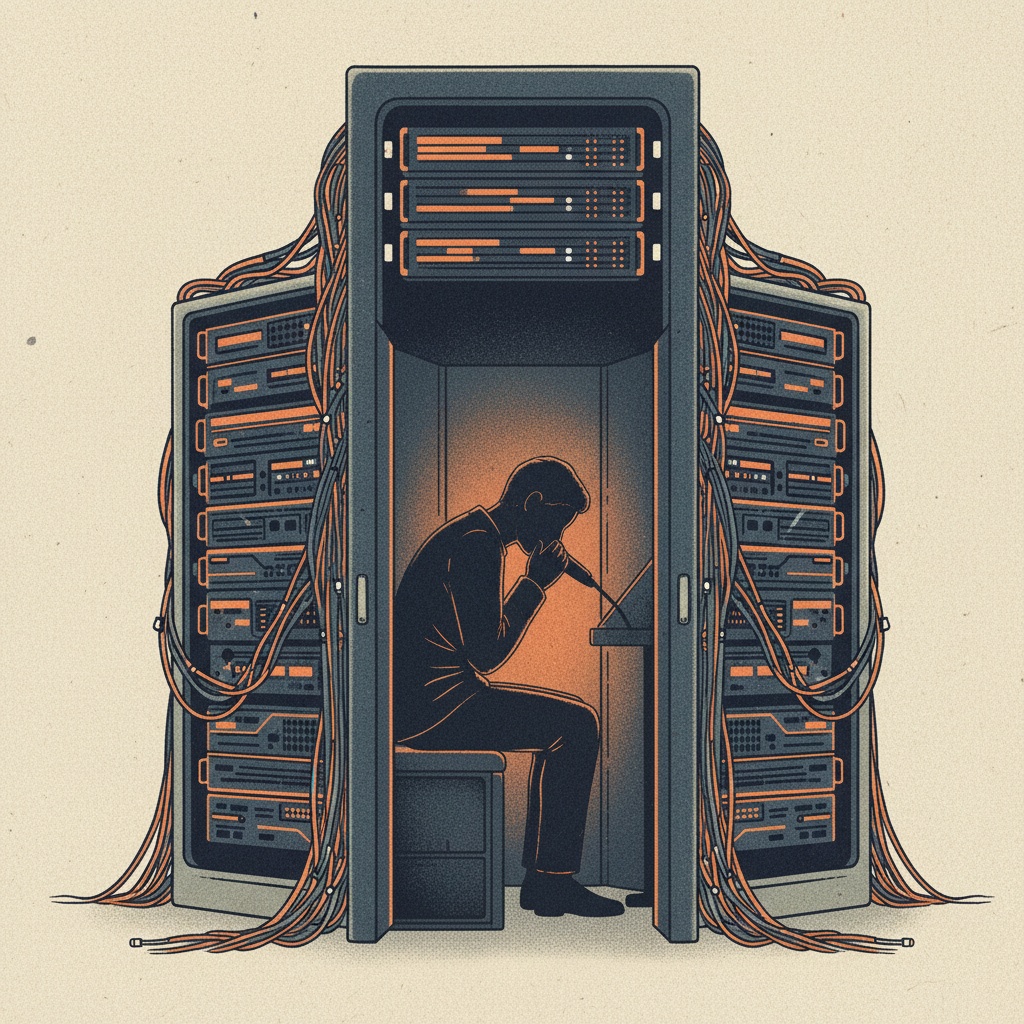
On Thursday, a Hacker News user named andrehacker posted a prompt that immediately caught fire: “What was your ‘Oh Shit’ moment with GenAI?” The thread, still climbing past 700 comments by Friday evening, is a digital confessional booth for the technically employed. Engineers, designers, product managers — each recalling the instant they realized the tools they’d been tinkering with had quietly circled back to face them.
The stories follow a pattern. Someone pastes a legacy codebase into a model and watches it generate a refactor in 90 seconds. A translator sees an LLM produce idiomatic Spanish from garbled input. A junior associate at a law firm feeds a deposition transcript into a tool and gets a competent summary before her second coffee.
The thread’s emotional arc is consistent: wonder, then vertigo, then a scramble toward reassurance. Almost every poster lands somewhere near “but of course, human judgment still matters.” Almost nobody sits with the vertigo long enough to ask why they’re asking the question at all.
The Fear Hierarchy Hidden in Plain Sight
What’s striking about the thread is not the moments themselves — creative professionals have been cataloguing theirs since Midjourney’s v3 release in mid-2022. It’s who is having them now. These are not illustrators or voice actors or copywriters. These are the people who spent 2023 and 2024 assuring everyone else that AI would “augment, not replace.”
Last month, Uber confirmed it is slowing hiring because autonomous coding tools and AI systems now handle work once assigned to employees. Not in some distant future — in Q2 2026, with the calendar still warm. The company framed it as operational efficiency. The subtext is plainer: a headcount line item that previously required a human now requires a prompt.
This is the shape of the “oh shit” moment that HN’s commenters are circling but not quite landing on. It is not that GenAI can generate boilerplate or summarize meetings or write React components. It is that the boundary between “augmentation” and “replacement” was never a technical question. It was a managerial one. And the people now being managed are the same ones who spent two years explaining the distinction to their anxious colleagues in marketing.
Slack Messages Don’t Count as Solidarity
There is a particular irony to the collective processing happening in that thread. The same engineers who once rolled their eyes at artists’ concerns — “learn to prompt, adapt or die” — are now narrating their own vulnerability in the same cadence, hoping for a different audience reception. It will not arrive.
One engineer, posting from a recognizable FAANG handle, described feeding a PRD into a model and watching it produce a technical spec that would have taken him two days. “I just sat there,” he wrote. “Didn’t even feel like celebrating.” The moment is honest. What it omits is that he was not, until Thursday, particularly worried about the translator or the paralegal or the junior copywriter. Their displacement was abstract, a macroeconomic footnote. His is personal.
The structural problem here is not hypocrisy — or not only hypocrisy. It is that the people building and deploying these systems have no category for their own fungibility. They imagined themselves as pilots, not passengers. The thread is the sound of a cockpit realizing it may, in fact, be a cabin.
What the Thread Actually Measures
Strip away the tech-bro pathos and the HN thread is doing something more useful than its participants intend. It is measuring, in real time, who gets to be scared publicly and who was supposed to stay quiet.
A graphic designer who watched her client list evaporate in late 2023 didn’t get a 700-comment thread. Neither did the voice actor whose audiobook work dried up when synthetic narration became adequate. Those people had “oh shit” moments too. They were told, often by the very cohort now confessing their own existential wobble, that they simply needed to upskill.
So here is the column I am not writing: the one that says elite engineers are finally getting their comeuppance, some smug parable about the revolution devouring its children. That is too easy, and it misses the point.
The point is that the entire framing — “oh shit” as individual revelation — is a luxury. It presumes a baseline of professional stability from which one can be surprised. The people for whom GenAI was always going to be a threat did not have a moment. They had a slow erosion. They are still having it. The thread is not a census of who AI will affect. It is a census of who was comfortable enough to think it wouldn’t affect them.
“We’re all talking about the same thing,” a contractor told me in a Slack channel for a mid-size fintech firm, “but half of us have been living it for two years and the other half just got the memo.”
The Realignment Nobody’s Naming
If there is a contrarian take here, it is this: the HN thread is not evidence that AI has crossed some new threshold. It is evidence that the people with the largest microphones have finally noticed what the people without them have been saying since 2023. That is not a technology story. It is a status story.
The column I most want to read is not about which professions AI will automate next. It is about why we needed 700 engineers to have a collective panic attack before anyone agreed the panic was legitimate. That is not a question about GPT-5’s parameter count. It is a question about who gets to set the terms of concern — and why the terms always seem to shift the moment the concern reaches the people setting them.
Sources
- r/hackernews - Reddit
- Ask HN: What was your “oh shit” moment with GenAI? - Hacker News
- Ask HN: Who is hiring? (June 2026) - GitHub Pages
- Enterprise AI adoption in 2026: Why 79% face challenges … - Writer
- AI Layoffs Are Becoming the Defining Business Story of 2026 | Times Square Chronicles
- Top 20+ Predictions from Experts on AI Job Loss