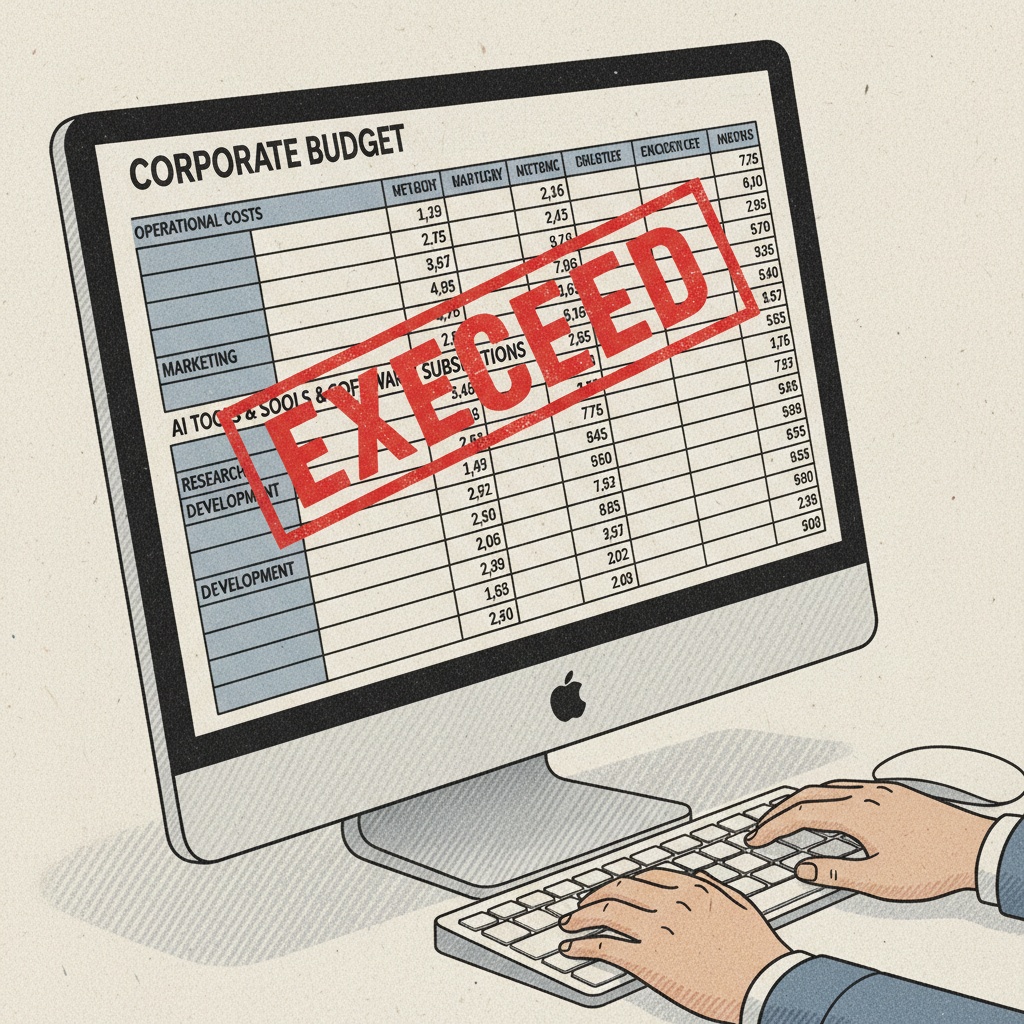
On Tuesday, Bloomberg reported that Uber Technologies had imposed a hard cap: $1,500 per employee, per month, per AI coding tool, after the company blew through its entire 2026 AI budget in the first four months of the year. The rideshare giant, whose CEO Dara Khosrowshahi said last month that roughly 10% of its code was now submitted by AI agents, framed the cap to Bloomberg as “a pretty straightforward way to responsibly encourage agentic AI adoption and experimentation at scale.”
The phrasing is doing a lot of work. “Responsibly encourage” is the kind of language that gets written when you need to tell shareholders you’re maintaining discipline while telling engineers you’re not taking their toys away. But the number itself — $1,500 a month per tool — is not the interesting part of this story. The interesting part is that a company of Uber’s scale can burn through a year’s worth of AI budget in four months without anyone apparently noticing until the budget was gone.
That does not happen with enterprise software. Nobody accidentally blows their annual Salesforce spend by March. You don’t discover in April that the whole company ran through its AWS commitment in a quarter. Those costs are visible, negotiated, forecasted. The fact that AI coding tools managed to slip the leash tells you something about who is making the spending decisions — and who is capturing the productivity.
The Meter Is Running on the Individual, Not the Institution
The $1,500 cap is per employee, not per project or per team. That is revealing. Uber is not saying “we have X dollars to spend on AI coding this year and we’ll allocate it to the highest-return projects.” It is saying “each engineer gets an allowance.” This treats AI tools the way companies treat gym memberships or conference budgets — a personal perk with a ceiling, not a strategic capital investment.
But the tools in question — Claude Code, Cursor, and their ilk — are not gym memberships. An engineer who uses one effectively can produce far more code than an engineer who doesn’t. The productivity delta is real and large. The problem is that the pricing model charges by the token, per individual session, meaning the cost scales with usage at the individual level, while the productivity gains are captured by the firm. The engineer gets the tool, the firm gets the output, and the vendor gets paid by the drink.
This is a quiet inversion of how technology spending usually works. When a firm buys a bulldozer, it pays once and amortizes the cost across years of digging. When it hires a backhoe operator, the operator doesn’t bring their own machine and bill the company per scoop. But in the AI coding world, every prompt is a micropayment, and the engineer making those prompts is the one deciding how many scoops to take. The budget blowout at Uber suggests engineers were using these tools as fast as they could because the tools made them faster — and nobody had put a meter on the behavior until the meter had already run dry.
The Real Risk Isn’t Overspend, It’s Under-Innovation
The predictable corporate response to this is exactly what Uber did: impose a cap. Problem solved. Budget controlled. Next quarter’s numbers will look fine.
But a cap like this doesn’t just limit spending. It limits experimentation. The engineer who wants to spin up an agent to refactor a legacy codebase, generate test coverage, or prototype a feature in an afternoon now has to think about whether the task is worth burning part of their $1,500 allowance. That mental math changes behavior. It pushes engineers toward using AI for the things they know will work rather than the things that might work. The safe bet. The incremental improvement.
“I’ve got developers on my team who were running the thing on autopilot for hours at a stretch, iterating through design ideas,” said one engineering manager at a mid-sized logistics firm, speaking in a Slack channel full of peers comparing notes on the Uber news. “Now I have to tell them to stop because we might hit a number? What’s the number for?”
That question is not rhetorical. If these tools genuinely increase developer productivity by 30% or 40% — and Khosrowshahi’s 10% AI-authored code figure suggests something in that neighborhood — then the cap is not a cost-control measure. It is a cap on innovation velocity, measured in dollars no one has calibrated against the value of the output. Uber is flying blind on ROI not because it’s hard to measure but because the pricing model makes cost visible before benefit is.
The Pricing Model Will Break Something — Probably Not What You Expect
There are two ways this resolves. Either the vendors figure out that seat-based or enterprise-wide licensing is better for customer retention than metered billing — which would make AI coding tools behave more like every other enterprise SaaS product — or companies start building internal tooling that bypasses the per-token model entirely. Neither is a crisis for the AI industry. Both are a problem for the current generation of startups that have built their revenue forecasts on per-token usage curves that assume engineers will keep prompting indefinitely.
Uber’s $1,500 cap is not a sign that AI is too expensive. It is a sign that AI is priced in a way that makes the buyer — the individual engineer — price-insensitive while making the payer — the corporate budget office — price-panicked. That gap will close. What gets squeezed in the meantime is not the technology. It is the engineer who learns, in month five, that the tool that made her twice as productive now requires a manager’s signature.
Sources
- $UBER is capping AI coding tool spend at $1,500 per employee per …
- Uber caps monthly employee AI spending at … - Yahoo Finance
- Uber enforces $1,500 monthly AI spending cap per employee as …
- Uber caps staff use of AI coding tools after blowing its budget
- AI too expensive: Uber restricts employees from using tools like …