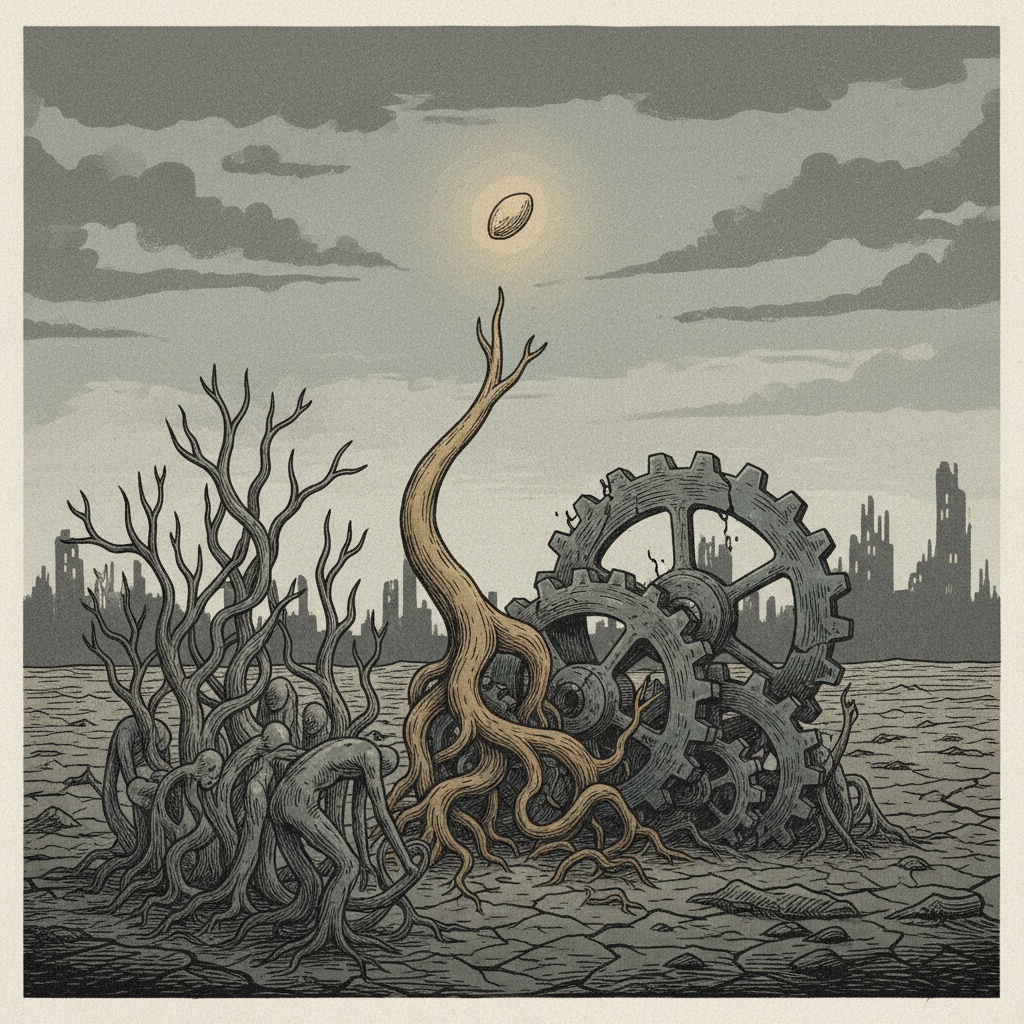
On Thursday, the New York Times ran a piece about Schneider Electric, the French multinational, which has spent the past two years quietly doing something that a growing number of CEOs apparently consider heretical: using AI to make its workers more productive rather than replacing them.
The timing was impeccable. The story landed the same week that viral Substack essay — Owen McGrann’s “The Dead Economy Theory” — was still ricocheting around Hacker News and every group chat in the knowledge economy. McGrann’s thesis, in compressed form, is that we are sleepwalking into an economy where machines produce for machines, where the labor of human beings is no longer the point of the system, and where no one has a plan to stop it.
The essay is sharp, literate, and almost entirely correct about the diagnosis. It is also, in one crucial respect, a kind of surrender.
What Schneider Electric Actually Did
The numbers matter here. Schneider employs roughly 150,000 people across more than 100 countries. Rather than using its AI deployment to trim headcount — the path chosen, as the Times noted, by firms that have announced “tens of thousands of layoffs” in recent weeks alone — the company retrained workers on AI-augmented manufacturing processes. The machines didn’t replace the floor operators; they gave the operators real-time data on energy consumption, predictive maintenance flags, and production bottlenecks.
The result, according to the company’s own disclosures, was a measurable productivity gain without a corresponding headcount reduction. This is not charity. Schneider is a publicly traded company with $36 billion in annual revenue. It made a calculation. It just made a different one than the bank boss who described layoffs, in the Times’s phrasing, as replacing “lower-value human capital.”
The Essay’s Quiet Cop-Out
McGrann, to his credit, is honest about the limits of his own argument. In a follow-up post on Substack, he wrote that he doesn’t “have a prescription for how to get out from under it.” The response is disarming in its candor. It is also, read uncharitably, an abdication.
The Dead Economy Theory describes a world in which capital has decided that labor is a cost to be engineered out — that the AI agent doing “the work of ten analysts” is the product, and the ten analysts are just overhead. But describing that world as though it is an emergent property of the technology, rather than a sequence of choices made by specific people in specific boardrooms, is the kind of category error that turns sharp critique into ambient pessimism.
As one plant manager at a Schneider facility in the Midwest told a trade publication last month: “We didn’t get a memo from headquarters saying ‘augment, don’t replace.’ We got asked whether we could hit new efficiency targets with the tools they were giving us. We said yes. Some other companies asked a different question.”
The Question You Ask Determines the Answer You Get
The Schneider case doesn’t prove that the dead economy thesis is wrong. It proves that the thesis is contingent. There is no law of capitalism that says AI must hollow out the workforce. There is only a prevailing management philosophy — call it the “lower-value human capital” school — and a set of incentives that currently reward it.
Those incentives are not mysterious. Public companies are valued on margins. AI tools promise margin expansion through headcount reduction. The math is easy to model and even easier to sell to shareholders. What Schneider did — invest in retraining, accept thinner near-term margin gains, bet that augmented workers would compound into something harder to copy — is harder to model. It requires a story, not just a spreadsheet.
But the fact that one company can do it means the others are choosing not to. That is a very different problem than the one McGrann describes. A world where the economy is “dead” because the technology inevitably leads there is a world where nothing can be done. A world where the economy is being steered toward a bad outcome by people who could steer it elsewhere is a world where something can be done — and where the people doing the steering deserve to be named, pressured, and, where necessary, embarrassed into changing course.
Fatalism Has a Constituency
This is where the essay’s popularity becomes uneasy. “The Dead Economy Theory” has been read and shared widely among exactly the people who might be expected to do something about it: managers, investors, policymakers, the professional class. A diagnosis this bleak, offered without a prescription, is catnip for people who want to feel intelligent about a problem without feeling responsible for it.
The unnamed bank boss who talked about replacing “lower-value human capital” probably forwarded the essay to his team. It flatters the reader’s sophistication while demanding nothing of them. The Schneider story, by contrast, demands something: a recognition that the path not taken was there all along, and that the people who didn’t take it made a choice.
The dead economy isn’t dead. It’s being killed, deliberately, by people who know what they’re doing. That’s worse — but it’s also, strangely, more hopeful. You can’t argue with inevitability. You can argue with a decision.
Sources
- Owen McGrann (@owenmcgrann)
- The Dead Economy Theory - by Owen McGrann - The Palimpsest
- Comments - The Dead Economy Theory - by Owen McGrann
- A.I. Doesn’t Have to Mean Layoffs - The New York Times
- AI Agents to Cause Massive Job Cuts in 2026 - Optimize Smart
- Layoffs Accelerate in May 2026 as Firms Restructure Around AI