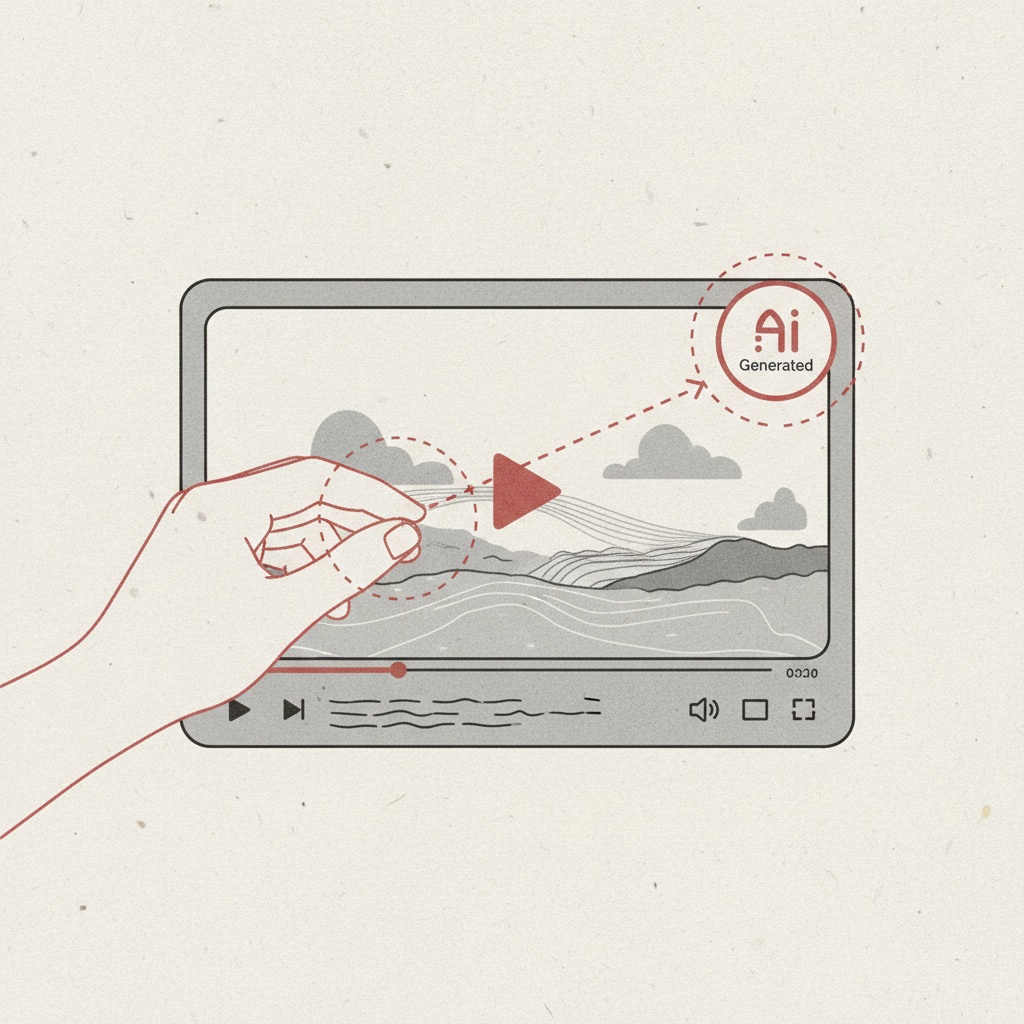
On Wednesday, YouTube announced that, starting this month, it will begin automatically applying “more visible” labels to videos that contain “significant photorealistic AI use.” No longer buried in an expanded description panel that nobody clicks, the new label will appear directly on the video — bottom left on Shorts, prominent on standard uploads. The company framed the move, reasonably enough, as a transparency upgrade. Viewers deserve to know what they’re looking at.
Hard to argue with. And yet the announcement, read in full, reveals a quieter detail that deserves more attention than the label’s font size. The automatic detection system will look for photorealistic AI use — meaning the label will almost exclusively attach to the category of AI content that looks, by design, indistinguishable from the real thing. AI-generated cartoons, abstract music videos, the endless slurry of synthetic B-roll that already pads out explainer channels? Not the target. The target is the stuff that might fool you.
The assumption embedded in this policy is that the label is a corrective — that once viewers see the badge, they will adjust their expectations accordingly, discounting the video’s truth claims, watching with a more skeptical eye. That assumption holds if the viewer wants to be undeceived. What if they don’t?
The Aesthetic Filter Nobody Asked For
Consider how content actually circulates among younger viewers. Algorithms serve slop. Stumble onto a viral clip of something implausible — a politician saying something too candid, a celebrity in an unlikely confrontation — and the first question many people ask, increasingly, is not “Is this real?” but “Is this AI?” If the answer is yes, the clip transforms. It does not become worthless. It becomes a different genre. Uncanny, eerie, distinctly synthetic — a vibe.
An AI label, in that viewing culture, does not suppress engagement. It categorizes it. The label becomes metadata for an aesthetic, not a credibility downgrade. “AI-generated” is already a content tag people seek out on purpose. Search any platform for “AI short film” or “AI-generated commercial” and you will find audiences who are there precisely because of the tool, not despite it. A more visible badge does not warn them away. It helps them find more of what they already want.
One creator who runs a moderately successful VFX channel — roughly 400,000 subscribers, mostly tech demos and breakdowns — told me over Discord on Thursday that he sees the label as, in his words, “free genre tagging.” He added: “If YouTube slaps AI on my thumbnails for me, that’s one less thing I have to A/B test. Viewers who hate AI will skip. Everyone else clicks harder.”
He is not being cynical. He is describing how platform design actually interacts with taste.
The EU’s Invisible Hand
It is also worth noting what lit the fire under this rollout. The EU’s AI Act, Article 50, becomes enforceable on August 2, 2026 — roughly nine weeks from now. Non-compliance can cost platforms up to €15 million or 3% of global annual revenue. Wednesday’s announcement was framed by YouTube as a consumer-friendly update. It is also, transparently if you read between the lines, a regulatory compliance calendar item. The platform needs a demonstrable, automated labeling system before the deadline, and it needs one now.
This is not a criticism of the EU. It is, however, context that helps explain why the system’s stated goal — viewer protection — may drift from its actual effect. Regulators want the labels to function as nutritional information: read this and make informed choices. Platforms need the labels to function as liability shields: we told you, now it’s on you. Neither outcome depends on viewers using the label the way regulators imagined.
What Happens When the Label Is the Point
The deeper tension is this: the more sophisticated synthetic media becomes, the more the AI label stops functioning as a credibility marker and starts functioning as a provenance marker — a kind of digital terroir. This video was shot in Prague. This one was generated by Omni. Both are metadata. Both describe origin. Neither, on its own, tells you anything about whether the content is worth your time.
If anything, the label may subtly credentialize AI content by giving it an official designation. A permanent badge — which YouTube says will apply to videos created with its own AI tools like Veo and Dream Screen — does not scream “caution.” It screams “product.” It tells you this video came from a Google pipeline. For some viewers, that will be more reassuring than a video with no label at all.
None of this means YouTube is wrong to label. Transparency is better than opacity, full stop. But the labels are landing in a media environment where the meaning of “AI-generated” is already unstable, and getting more so. Wednesday’s announcement assumes the label answers a question. Within a year, I suspect the label will be the question. Viewers will see it and ask not “Should I trust this?” but “What kind of AI is this, and do I like that kind?” — the same way they already evaluate CGI, animation styles, or whether a podcast was recorded on a Blue Yeti.
The transparency project is noble. The audience, however, is already running a different playbook entirely.
Sources
- YouTube to begin automatically labeling AI videos - Ars Technica
- YouTube’s NEW RULES Just Changed Everything…(2026 Update)
- AI content on YouTube to get bigger, ‘more visible’ warning label
- YouTube to add automatic AI labels for undisclosed generated content | LiveNOW from FOX
- YouTube’s Algorithm Update Just Changed The AI Rules For …
- YouTube to Automatically Label AI-Generated Videos … - Variety