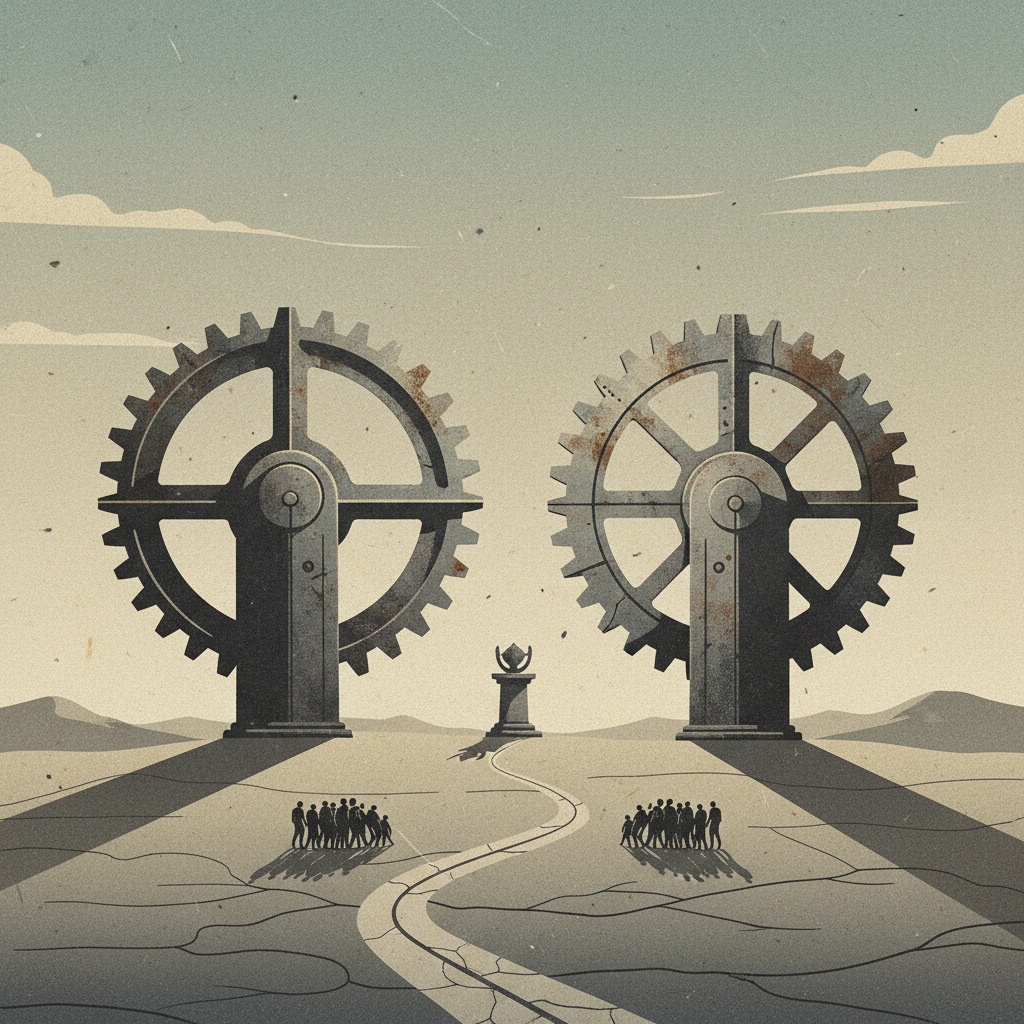
On Monday, The Information reported that OpenAI pulled in $5.7 billion in revenue during the first quarter of 2026. Anthropic, its chief rival, posted $4.8 billion. Both figures are staggering. Both are up dramatically year-over-year. And both represent something the industry has spent two years waiting to see: genuine, durable demand from customers who aren’t just kicking the tires.
Simon Willison, the open-source developer and AI commentator whose blog posts reliably set the conversational agenda, declared this week that both companies have found product-market fit. He’s not wrong. But the frame is too tidy. The phrase “product-market fit” conjures images of organic discovery — users finding something they love so much they can’t stop using it. What’s actually happened is stranger, less romantic, and far more consequential for how AI gets built.
The Buyer Is Not the User
When a SaaS startup finds product-market fit, engineers are the buyer. They adopt Slack or Figma or Datadog because it makes their workday better. The finance department pays the bill after the fact. That’s not what’s happening here.
OpenAI’s $5.7 billion quarter didn’t come from individual developers hitting a Stripe checkout page. It came from enterprise license agreements. From procurement departments negotiating seat counts and data-residency provisions. From CIOs being told by their boards to “have an AI strategy” and signing multi-year commitments. The buyer is the executive layer. The user — the employee who actually interacts with the model — has vanishingly little say in whether the tool stays or goes.
“We’re using both,” one procurement director at a Midwest insurance firm told me over Slack DM. “I couldn’t tell you which one is better. I could tell you which one gave us better volume pricing.”
That’s not product-market fit in the textbook sense. That’s something else entirely.
The Silent Pivot
Nobody objects to enterprise revenue. The problem is that both companies’ product roadmaps now answer to the procurement buyer, not the individual user. Features are prioritized by what closes six-figure deals, not what delights a researcher at 11 p.m.
You can see it in the release notes. Both Anthropic and OpenAI now ship long-context support, RBAC permissions, audit logs, SOC 2 reports, data residency guarantees — all things that matter enormously to a Fortune 500 CISO and not at all to someone who just wants the model to be smarter. Both companies are converging on the enterprise feature set because both are chasing the same procurement budgets. The $5.7 billion and $4.8 billion quarters represent the same dollars being fought over by the same two vendors with increasingly identical products.
Duopolies don’t compete on product quality. They compete on distribution, bundling, and enterprise features that procurement departments use to justify purchases to their compliance teams. That’s the phase we’ve entered. Willison’s framing calls this “product-market fit.” It’s closer to vendor lock-in for the C-suite.
What the Numbers Don’t Say
Neither company is profitable. OpenAI burned cash at a rate that would embarrass a pre-revenue biotech, and Anthropic is not far behind. The $5.7 billion quarter is revenue, not margin. Calling it product-market fit implies sustainability. But if both companies need to triple revenue again just to cover compute costs, we’re not describing a healthy market — we’re describing a subsidy war backed by Microsoft and Amazon.
A Wall Street analyst who covers enterprise software told me in a courthouse hallway last month: “If two companies are selling AI and the marginal cost of inference keeps dropping, but neither can show positive unit economics, you’re not looking at product-market fit. You’re looking at a price war neither can afford to stop.”
There’s a genuine achievement here. Two companies persuaded thousands of large organizations to pay billions of dollars for experimental software, and those organizations aren’t canceling. That’s real. But the fact that the revenue comes from the procurement layer, not the user layer, means the incentives are warped. The people choosing the tool aren’t the people using it. And when that happens, the product drifts toward what’s easy to sell, not what’s useful to use.
Call it enterprise lock-in. Call it a duopoly. Call it procurement capture. Just don’t confuse it with love.
Sources
- Anthropic Just Passed OpenAI in Revenue. Here Is Why It Matters.
- Anthropic Just Passed OpenAI in Revenue. While Spending 4x Less to Train Their Models
- Anthropic revenue (annualized): April 2026 - $30B : r/ClaudeCode
- OpenAI Made $5.7 Billion in Q1 2026. Your Data Science Salary …
- OpenAI Generated Nearly $6 Billion in Revenue in First Quarter …
- OpenAI Revenue, Losses, and Profitability in 2026 - FutureSearch