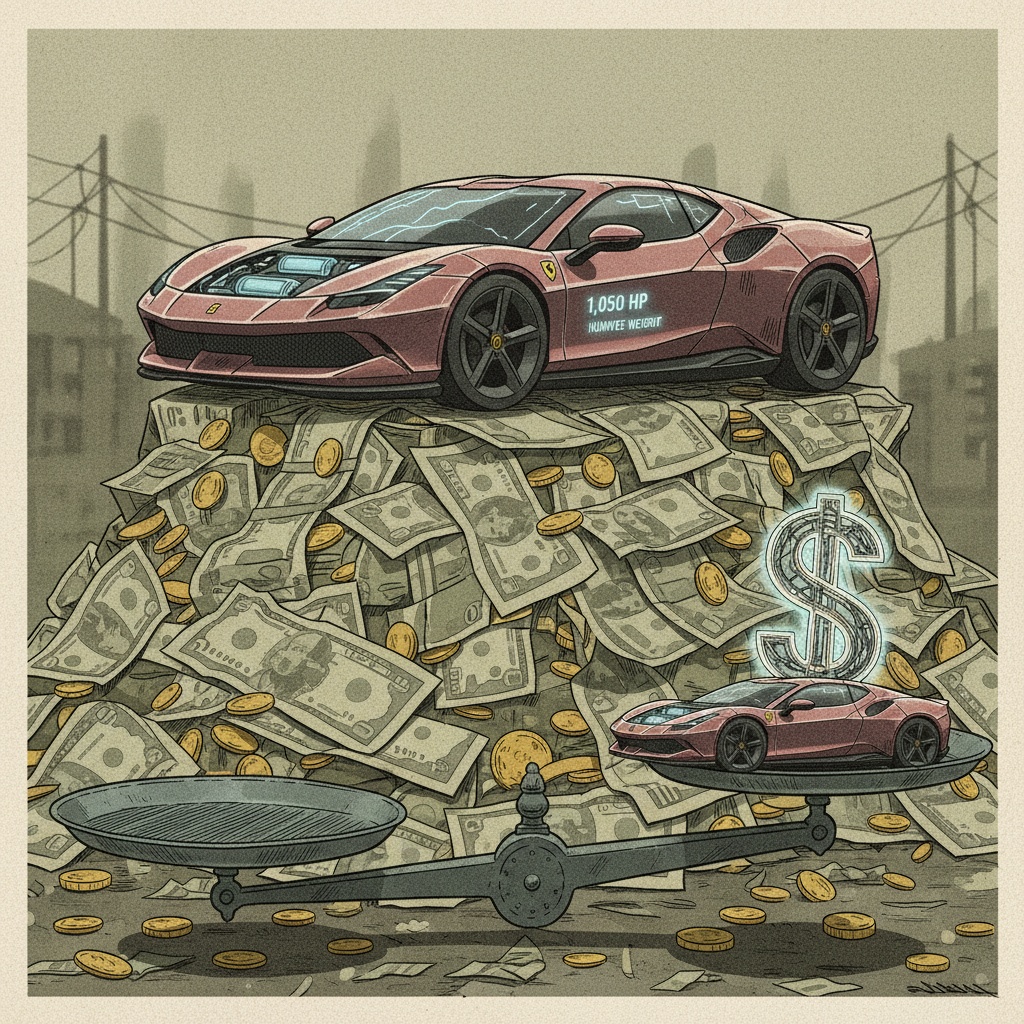
On Monday in Rome, Ferrari pulled the sheet off the Luce, its first fully electric production car. The numbers: four electric motors producing 1,050 horsepower, a 122-kWh battery pack, zero-to-62 mph in 2.5 seconds, a claimed 330 miles of range—and a starting price of around £500,000 before the inevitable bespoke options. The vehicle was unveiled May 25, exactly 79 years to the day since Ferrari’s first-ever race in the same city.
Conventional wisdom says this is the moment a legacy supercar brand proved EVs can be desirable, that electrification has genuinely arrived for performance purists. That take is not wrong, but it’s boring. What it misses is that the Luce is less a car than a statement of class segmentation—and the segmentation cuts in a direction the EV evangelists don’t like looking at.
The Curb Weight of a Small Truck
Let’s start with what’s missing from the breathless coverage. The Luce weighs 2,260 kilograms. That’s almost 5,000 pounds—within spitting distance of a Ford F-150 SuperCrew 4x4. For context, Ferdinand Piëch’s legendary V10-powered Carrera GT, which arrived in 2003 as an engineering masterpiece, weighed 1,380 kg. The Enzo, built in the same era, clocked in around 1,365 kg. Ferrari just unveiled a car that outweighs them by 65%.
There is a version of this column that stops here, deploys the word “soul,” and waxes poetic about lightness, purity, and the glory of the naturally aspirated twelve. I will spare you. But weight matters because it is physics, not poetry. A 2,260-kg sedan braking into a hairpin is a fundamentally different engineering problem from a 1,400-kg mid-engine coupe. Ferrari’s engineers are brilliant; they will make the Luce handle. The question is what “handling” means when every input is filtered through four motors and electronically managed torque vectoring, and the base physical platform is closer to a luxury barge than a mid-engine monster.
The Numbers the Evangelists Ignore
Ferrari pricing has always been stratospheric, but the Luce starts at roughly £500,000 before the tailoring program. A full-fat bespoke commission could push toward £700,000. For a four-door grand tourer. From a company that less than a decade ago considered the idea of a four-door—the GTC4 Lusso, which was a shooting brake, not a sedan—borderline sacrilege.
Here’s the uncomfortable fact: Ferrari didn’t build this car to democratize performance. It built it because the super-rich increasingly want silent, seamless acceleration in a package that makes them feel righteous rather than ostentatious. The Luce is a guilt-erasing machine. It says “I could have bought a V12” while also saying “but I didn’t,” and it charges a half-million-pound premium for the privilege. The price tag is the signal. Ferrari has figured out what the mass-market EV makers haven’t: the buyers who can afford the transition don’t want a “reasonably priced” electric car. They want a ludicrously priced electric car that announces they’ve moved on from fossil fuels without moving on from social superiority.
One engineer on the pit lane in Rome, who was not authorized to speak publicly, put it this way: “We don’t talk about sustainability here. We talk about the architecture of desire. The battery is just the new engine bay.”
What the Luce Actually Signals
The most important column you’ll never read about the Luce is the one about how Ferrari is proving that electrification works only at the extreme ends. At the bottom, you have Chinese manufacturers flooding the market with sub-$20,000 city EVs. At the top, you have Ferrari moving £500,000 sedans to customers who will spec them at £650,000. The middle—the Corvette Stingray buyer, the Porsche 718 customer, the BMW M enthusiast—is left watching from a strange limbo, where the internal combustion engine is dying and the electric replacement costs too much to sell profitably.
That middle is where most car enthusiasts actually live. They’re being told the future is electric by automakers whose electric cars lose money, while the one company that has figured out the economics did it by ignoring them entirely and selling to people with private jets. The Luce doesn’t prove the electric transition works. It proves it works for Ferrari, a company whose customers measure option packages in multiples of the median U.S. household income.
Monday’s event in Rome was a triumph of branding. The city, the date, the Ive/Newson interior—every detail managed. What it wasn’t was a validation of the idea that electrification scales to the enthusiast middle class. The Luce is a magnificent anomaly, and the best thing about it is that it doesn’t pretend otherwise.
Sources
- 2026 Ferrari Luce EV Sedan: UAE Price & Specs
- Ferrari Luce EV Price, Specs and Rome Debut Details - Hypebeast
- Ferrari’s First EV: The LUCE | Exclusive First Look Review 2026
- Ferrari just changed everything. Meet the Luce. Unveiled … - Instagram
- Ferrari just changed everything. Meet the Luce. Unveiled in Rome …
- Ferrari Luce First Look Review 2026: Ferrari’s First Fully Electric Car Revealed | DriverReviews