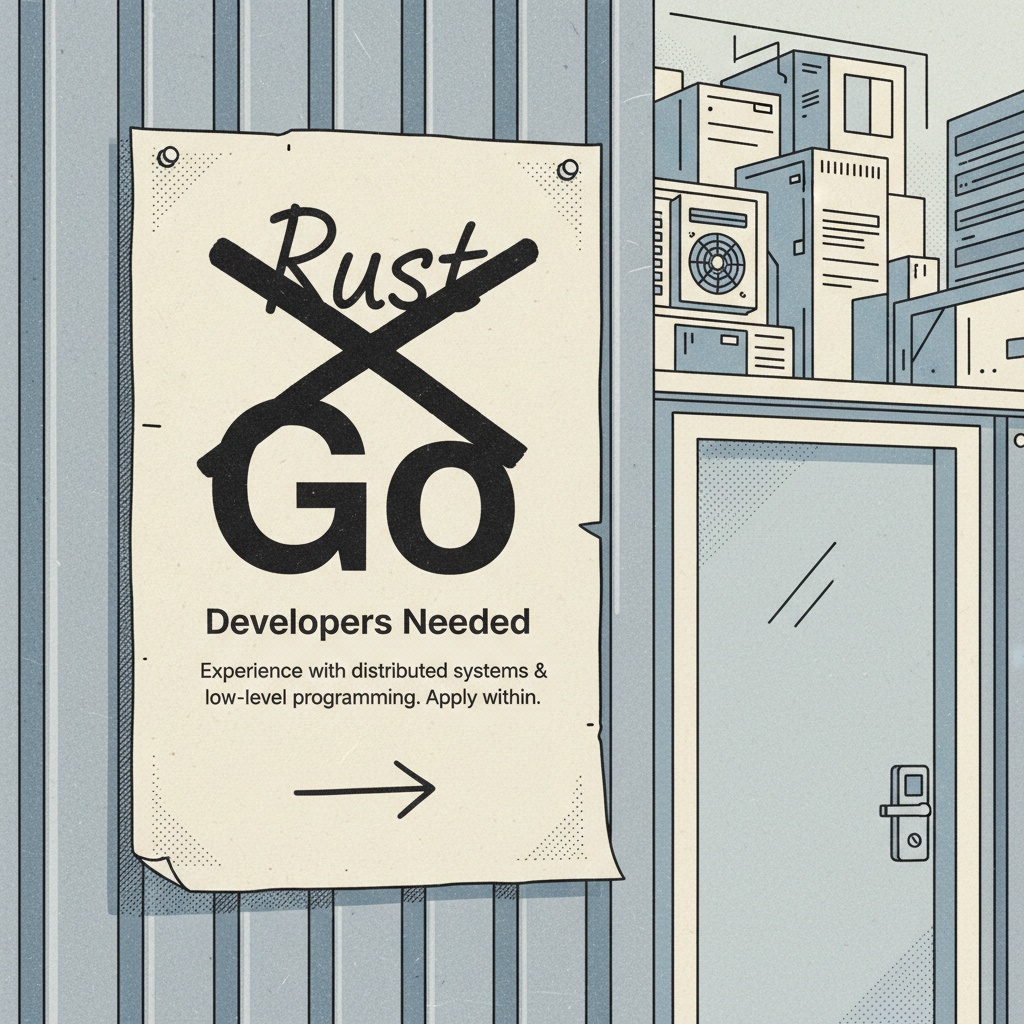
On May 22, the Rust consultancy corrode.dev published a detailed migration guide titled “Migrating from Go to Rust.” Within 48 hours it had racked up 281 points and 274 comments on Hacker News — the kind of thread where engineers litigate error-handling ergonomics and debate whether channels or async runtimes represent the one true path to concurrency. The guide itself is thorough, practical, and admirably evenhanded. It maps Go patterns to Rust idioms, walks through ownership vs. garbage collection, and offers real advice for teams contemplating the jump.
But here’s what the thread didn’t surface — and what the guide’s author, to his credit, all but admits in the opening paragraphs: for the services most teams are building, Go already “gets you most of the way there.” The performance delta exists, but it’s marginal for the I/O-bound workloads that dominate backend development. The type system is stronger in Rust, sure, but Go’s is perfectly serviceable for the kind of bugs that actually ship to production. The binaries are smaller? Great. Nobody’s cloud bill is determined by binary size.
So why are teams doing this?
The Author Knows What’s Happening
Read the guide closely and you’ll notice the framing. The author specializes in helping teams migrate. He’s not writing a “Go vs. Rust” comparison for language tourists. He’s writing for engineering managers who have already decided to make the switch and need a roadmap. These are not teams fleeing Go because their p99 latency spiked. These are teams — the guide says it plainly — “considering Rust” for services they haven’t written yet, or rewriting services that are already humming along just fine in Go.
This pattern isn’t new, but it’s accelerating. In 2025, the Rust Foundation’s annual survey reported that 34% of organizations using Rust had adopted it within the prior two years, with “backend services” overtaking “systems programming” as the dominant use case. That’s not the trajectory of a language being pulled into production by performance requirements. That’s a language being pulled in by hiring managers who have run the numbers on what kind of engineer they can attract with “Rust” in the job description versus “Go.”
One engineering director at a mid-sized fintech firm, standing outside a conference hall in Austin in April, put it to me this way: “We posted the same role twice — once with Go in the title, once with Rust. The Rust listing got three times the applicants, and the median candidate had five more years of experience. Same salary band.” He shrugged. “At that point, you’re not choosing a language. You’re choosing a recruiting funnel.”
The performance argument, in other words, is downstream of the talent argument. Managers talk about safety and speed because “we’re rewriting our stack to attract a narrower, more senior labor pool” doesn’t play as well in an architecture review.
What the Migration Guide Actually Teaches
The corrode.dev guide is an excellent piece of technical writing, and it inadvertently makes the labor-market case clearer than any editorial could. The bulk of the document is devoted to translating Go concepts into Rust: goroutines become tokio::spawn, defer becomes Drop, interface{} becomes trait objects. This is not the language of a fundamentally different paradigm. This is a Rosetta Stone for engineers who already know what they’re doing and just need the syntax.
The implication is uncomfortable for both camps. For the Go faithful, it suggests that Go’s vaunted simplicity — the thing that made it the default language for cloud infrastructure — is now a liability in a market that rewards signaling complexity. For the Rust evangelists, it suggests that their language’s growth isn’t being driven by its technical merits so much as by its cultural cachet among senior engineers who are tired of interviewing at Java shops.
Neither side wants to admit this. The Go community prefers to frame the exodus as a fad — “rewrite it in Rust” as the new “rewrite it in Scala” — while the Rust community prefers to frame it as an engineering inevitability. Both narratives are comfortable. Both are wrong.
The Real Cost Nobody Calculates
None of this is to say that migrating from Go to Rust is irrational. If you’re a CTO trying to hire senior backend engineers in a market where the best ones are disproportionately applying to jobs that say Rust, rewriting a few services is cheaper than leaving headcount unfilled for nine months. The calculus is cynical but it’s not stupid.
The problem is that nobody writes this cost down in the migration proposal. The slide deck says “improved memory safety,” “reduced cloud spend,” “better type system.” It doesn’t say “our Go job listings were attracting mid-level engineers from bootcamps and we wanted senior engineers from FAANG who are bored of Go.” But that’s the real math.
And once you see it, you can’t unsee it. Every major Rust adoption story of the past two years — the Discord migration, the Dropbox storage engine rewrite, the Cloudflare Pingora proxy — gets reframed. These were smart technical decisions, yes. They were also announcements to a specific labor market: We are the kind of company where serious systems engineers want to work.
A Signal, Not a Solution
Here’s the danger: treating language choice as a recruiting tactic works until it doesn’t. Rust is harder to hire for than Go, not easier — the applicant pool is just different. The median Rust engineer commands a higher salary, expects more autonomy, and will leave sooner if the work doesn’t match the promise. The fintech director I mentioned earlier got his applicants, filled his roles, and then spent the next year managing a team that was overqualified for the actual work of maintaining CRUD endpoints behind an API gateway. Two of them left within 14 months.
Migration guides like corrode.dev’s are genuinely useful. Teams should have them. But the next time you see an internal proposal to rewrite a working Go service in Rust, read past the performance benchmarks and latency graphs. Ask what kind of resume the company is trying to attract — and what happens when those resumes arrive and discover the work is still just shuffling JSON between databases.
Because the migration guide will get you to production. It won’t tell you what to do when the engineers you hired for the rewrite realize they were the real product all along.
Sources
- Rust Learning Resources 2026 | corrode Rust Consulting
- Migrating from Go to Rust | corrode Rust Consulting
- Migrating from TypeScript to Rust | corrode Rust Consulting
- Job-focused list of product companies using Rust in production — 2026 (ReadyToTouch) - announcements - The Rust Programming Language Forum
- My Professional Bet: 4 Unstoppable Rust Trends Changing …
- While big companies are migrating from Golang to Rust, how does …