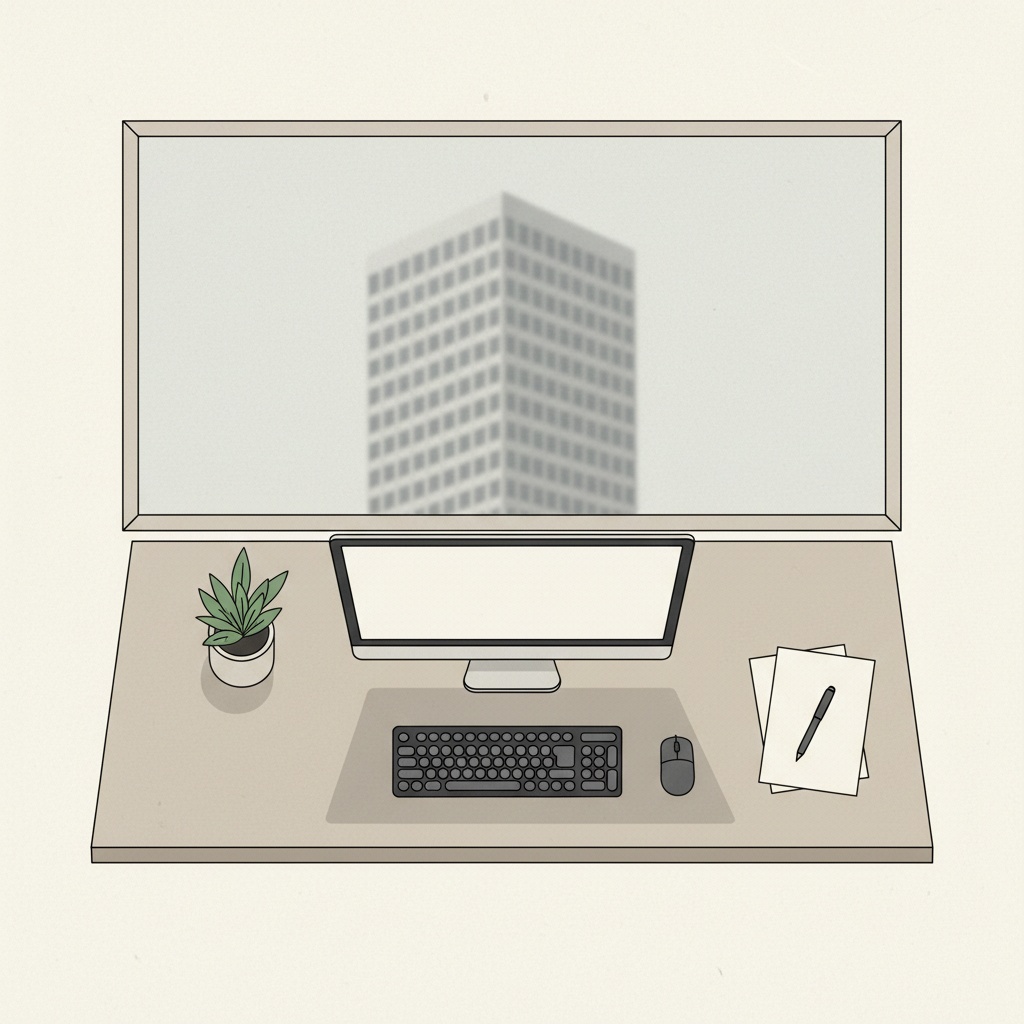
On November 18, 2025, a software engineer named Fatih Arslan published a 2,300-word blog post cataloguing his two-part desk setup: one station for deep work, another for meetings, every cable managed, every monitor angle documented, every keyboard switch preference justified. It sat quietly for six months. Then, this week, it hit the front page of Hacker News and racked up 308 upvotes and 177 comments — roughly the same traffic a startup’s Series A announcement gets on a good day.
Something about that timing is not accidental.
A blog post about a home office from late 2025 shouldn’t be trending in late May 2026. But look at the calendar: TikTok mandated five days a week in-office in January. NBC Universal pushed to four days. US Bank locked in three. The return-to-office wave that executives spent 2023 and 2024 bluffing about is actually landing now, in 2026, with enforcement teeth. Badge-swipe tracking is real. Managers have been trained on the “accountability” talking points. The era of the pandemic home office — that glorious, improvisational period when a dining table and a refurbished ThinkPad counted as a workspace — is being systematically dismantled from the top down.
And so the desk setup post goes viral. Not despite the RTO wave. Because of it.
The $4,700 Standing Desk as Psychological Real Estate
MillerKnoll, the conglomerate behind Herman Miller and Fully, reported $872.3 million in net sales for its most recent quarter — an 11.4% year-over-year decline, accompanied by workforce reductions. The commercial office furniture business is waiting on a corporate reordering cycle that keeps getting pushed out. Companies aren’t refitting their floors yet, in part because they’re still figuring out how many people will actually show up.
But the consumer side tells a different story. The desk setup genre — YouTube tours, Reddit battlestation threads, the entire #desksetup ecosystem on Instagram — has only intensified. These are not cheap rigs. A serious standing-desk build with a quality chair, an ultrawide monitor, a mechanical keyboard, a calibrated microphone arm, and acoustically treated wall panels runs north of $4,000. Some configurations in the r/macsetups subreddit push past $7,000. These are investments people make after the home office becomes permanent in their minds.
And that’s the tension. The workers obsessing over desk cable management are the same workers whose employers are currently rolling back remote-work policies. The psychological transaction here is worth examining: when you know the room might be taken away, you decorate it more urgently.
“I finished my cable management the same week our RTO mandate dropped,” one remote product manager told me in a Slack DM. “I knew it was irrational. I didn’t care.”
What the Productivity Literature Won’t Admit
Remote-work advocacy has always relied on two arguments: productivity data and quality-of-life improvements. The productivity argument has genuine legs — Stanford economist Nick Bloom’s research has shown hybrid workers are about as productive as fully in-office ones, and the commute savings are real. But the desk-setup phenomenon reveals something the advocacy never quite says out loud: for many knowledge workers, the home office became a kind of occupational identity project.
These are not utilitarian workstations. Nobody needs a grovemade walnut desk shelf to write Jira tickets. Nobody needs a custom-coiled aviator cable connecting their keyboard to their PC. The point is the curation itself — the sense that this space, unlike the gray-carpeted bullpen with the broken coffee machine and the colleague who microwaves fish, is yours. You chose the lighting temperature. You chose the plant. You chose the art on the wall behind the webcam.
The return-to-office movement isn’t just asking people to commute again. It’s asking them to abandon a domain where they exercised near-total aesthetic and ergonomic control. That matters more than the commute.
The Thing They Can’t Mandate Back
RTO mandates are framed around culture, collaboration, and mentorship — the serendipitous hallway conversations that supposedly drive innovation. They are not framed around who controls the thermostat, or whether the overhead fluorescents give you a headache by 2 p.m., or whether the office chair is adjusted for someone who left the company eight months ago.
But those are the daily textures of work. And the desk setup genre is, at bottom, a genre about those textures — about the quiet insistence that physical environment is not a trivial detail. It is, for many people, the primary interface with their labor.
Employers can mandate badge swipes. They cannot mandate that anyone care about the office the way they cared about the setup they built themselves. That gap — between compliance and investment — is where the next few years of workplace culture will actually be negotiated.
The Hacker News thread under Arslan’s post is full of the usual comments: questions about monitor arms, debates about keyboard switches, one person asking about cable management clips. Nobody in that thread is talking about RTO mandates. They’re talking about their desks. But they’re also, unmistakably, talking about the one workspace they still control — right at the moment that control is shrinking.
The sports car cliché was always a lazy shorthand for midlife crisis. The desk setup may be its quieter, more functional, and far more telling successor.
Sources
- Essential Return-to-Office Statistics and Trends (2026)
- Remote Work Statistics and Trends for 2026 - Vena Solutions
- Top 10 Trends That Will Redefine Remote Work in 2026
- 04/30/2026 Office Furniture Liquidations Live Video - YouTube
- Herman Miller Waits for Employers to Step Up Orders for New Office …
- MillerKnoll reports decline in Q3 sales; reduces workforce