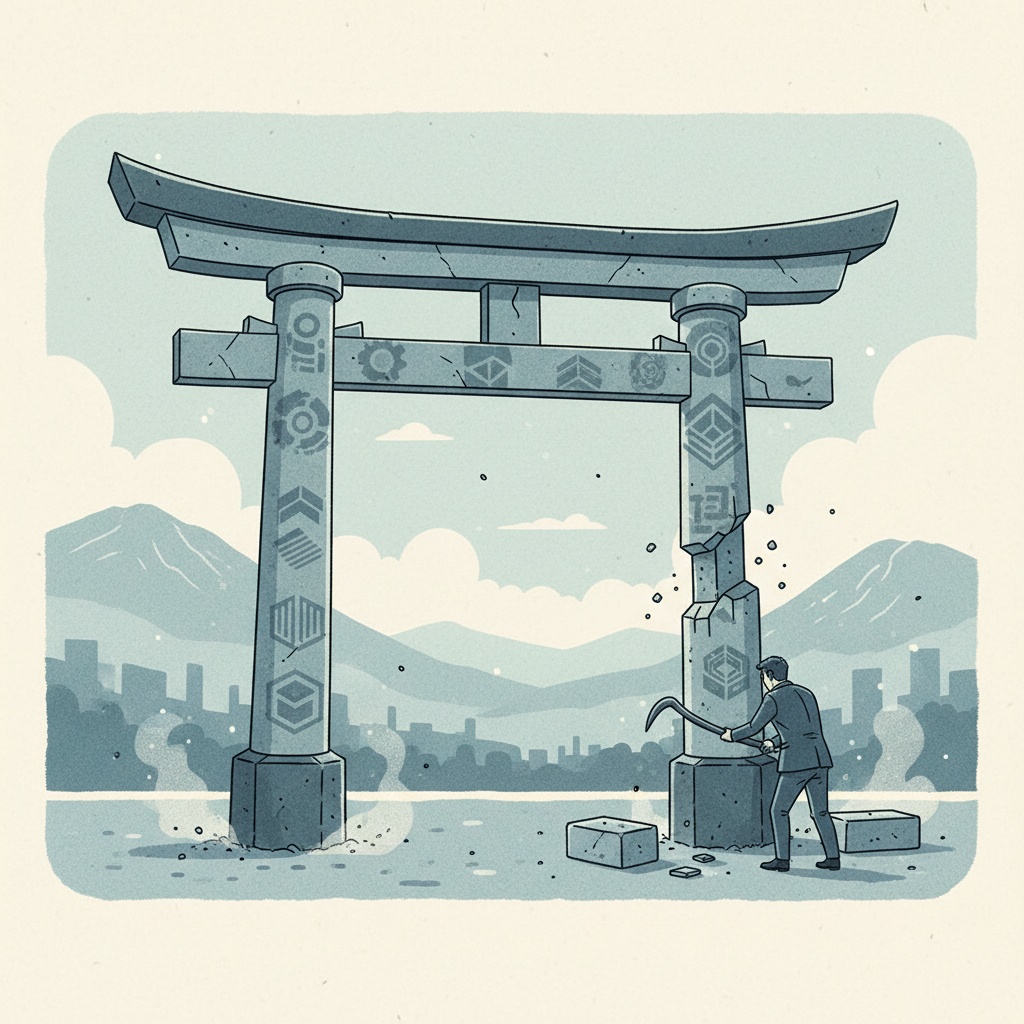
On Monday, the Japan Research Institute published a report tallying something that would have been unthinkable a decade ago: 56 activist shareholder campaigns against Japanese listed companies in 2025, a record. The number is not a blip. The report, dated May 19, projects the pace accelerating through 2026, driven by foreign institutional investors and a Tokyo Stock Exchange that has quietly transformed from a protector of corporate inertia into something closer to an accountability mechanism.
The internet spent this week sharing an essay about why Japanese companies do so many different things — the sprawling keiretsu that run rail lines, operate department stores, sell insurance, and manufacture semiconductors under one roof. The essay is charming, animated by genuine curiosity about a corporate form that looks alien to American eyes. But it misses the real story. The conglomerate is not some eternal artifact of Japanese business culture. It is a specific, contingent arrangement, and right now it is under the most sustained assault it has faced since the bubble era.
The TSE Didn’t Just Nudge — It Changed the Arithmetic
Corporate governance reform in Japan has a reputation for moving at the pace of continental drift. That reputation is now out of date. The Tokyo Stock Exchange’s market restructuring, completed in 2022, created new listing tiers with explicit governance requirements. More consequentially, the TSE began publicly naming and shaming companies that trade below book value — a list that includes a startling number of household-name conglomerates with sprawling, low-return divisions buried inside them. The message was unmistakable: the market will no longer politely ignore the discount investors apply to incoherent portfolios.
The Japan Research Institute report notes something crucial that most Western commentary misses. Activist demands in Japan have evolved beyond the standard playbook of “return more cash to shareholders.” Increasingly, investors are pushing for something more structural: the breakup of conglomerates into focused, independently listed entities. This is not a call for better capital allocation at the margin. It is an argument that the conglomerate form itself is destroying value.
“Five years ago, the conversation was dividends and buybacks,” said one fund manager working a Tokyo trading desk during the lunch break on Thursday, reviewing positions in two Japanese industrials. “Now the pitch decks have org charts with lines drawn through business units. The activists are basically presenting carve-out roadmaps.”
The Real Divide Isn’t East vs. West — It’s Patient Capital vs. Activist Capital
The standard narrative frames the Japanese conglomerate as a cultural preference: long-term thinking, stakeholder capitalism, an aversion to the quarterly-earnings myopia that plagues American firms. There is truth in that. But it is also an excellent justification for managers who would rather not be judged too closely on returns. The conglomerate form in Japan has historically served as a mutual non-aggression pact — cross-shareholdings among friendly institutions, boards staffed with lifers, and a gentleman’s agreement that no one would cause embarrassment by asking why the precision-instruments division earns 3% on capital.
What changed is not that Japanese managers suddenly embraced shareholder primacy. What changed is that the shareholder register did. Foreign institutional ownership of Japanese equities has risen substantially over the past decade. Those investors do not participate in the gentleman’s agreement. They look at a conglomerate trading at 0.7 times book value, see four or five businesses that would command higher multiples separately, and start making phone calls.
The Counterargument That Actually Deserves a Hearing
None of this is to say breakup activism is an unalloyed good. The conglomerate form has real advantages in a Japanese context — it allows internal capital allocation in a country where bank lending remains conservative and venture capital is thin, and it absorbs labor-market shocks in a system where layoffs carry stigma that American managers cannot imagine. A contractor in Osaka, smoking outside a job site operated by a subsidiary of a subsidiary of a trading company, put it plainly: “When one part of the group has a bad year, they move people. Nobody gets cut. You think the activists care about that?”
He is not wrong. The activist case for breakups is mathematically elegant and socially blind. That does not make the math wrong — many of these conglomerates really do destroy value — but it does suggest the transition will be messier than the pitch decks imply.
Still, the direction of travel is clear. The Japanese conglomerate is not being preserved; it is being dismantled, piece by piece, campaign by campaign, TSE disclosure by TSE disclosure. The charming essay about why Japanese companies do everything is, in its way, an elegy for something that is already disappearing. The real story of 2026 is not the phenomenon. It is the wrecking crew.
Sources
- Conglomerates Make a Comeback as Diversification Shields …
- JAPANESE ECONOMIC AND BUSINESS WEEKLY NEWSLETTER: 14 -23 March, 2026 | EU-Japan Centre
- Japan’s New Investment Horizon – Bloomberg Wall Street WeekApollo Global Management
- Squire: Activism should be even busier in 2026 as investors rotate …
- PDF The Rise of Shareholder Activism in Japan and Implications for …
- Japan Shareholder Activism Hits Record Highs in 2025 - LinkedIn