The Measure of a City
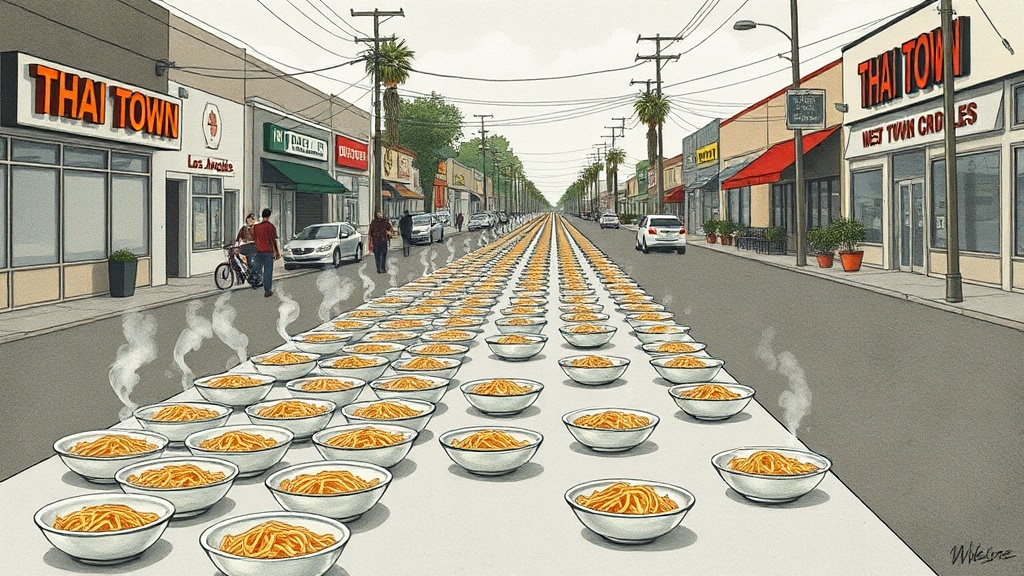
There was a time when great cities built cathedrals, bridges, and opera houses. Los Angeles, ever the innovator, is going for something else entirely: the Guinness World Record for most people eating Pad Thai simultaneously.
On April 26, 2026, in the heart of Thai Town, organizers hope to gather over a thousand souls to slurp rice noodles in unison. According to LAist, the attempt runs from 8 a.m. to 10 p.m., which is either impressive stamina or a sign that coordinating 1,200 amateur eaters requires military-grade logistics. Secret Los Angeles confirms that participants get an official Guinness certificate. Finally, something to frame beside the liberal arts degree.
A Cultural Exchange, Deep-Fried
Let me be clear: I have nothing against Pad Thai. It’s the gateway drug of Thai cuisine—safe, sweet, universally beloved. You could serve it at a child’s birthday party and no one would flinch. But there’s something almost perfectly on-the-nose about a city that once defined itself by cinema now defining itself by communal stir-fry.
A veteran event coordinator I spoke with—let’s call him “Tom from Pasadena, who has seen too many municipal PR stunts”—put it this way: “It’s not about the noodles. It’s about the photo. If a thousand Angelenos eat Pad Thai and nobody livestreams it, did it even happen?”
He had a point. The Thai SELECT certification, a Royal Thai Government program promoting authentic cuisine abroad, has been pushing “certified authentic” branding on everything from festivals to restaurant windows. The Instagram reel from Thai Fest by The Beach shows the logo slapped on what appears to be chow mein, which either says something about globalization or just proves that social media interns have a sense of humor.
The Rising Cost of Authenticity
Here’s the contrarian question no one at Songkran Festival wants asked: what happens to “authentic” when it becomes a municipal marketing strategy?
Thai Town is one of only four officially designated Thai neighborhoods in the United States. It’s a genuine cultural corridor, home to immigrants who built businesses, raised families, and made a corner of Hollywood feel like Bangkok-by-way-of-the-101. Now it’s also a backdrop for Guinness-hungry content creators.
The tension isn’t unique to Pad Thai. Every ethnic enclave in America eventually faces this fork in the road: preservation or performance? Chow mein confusion aside, the Thai SELECT program means well—certifying restaurants that maintain traditional standards. But there’s a faint whiff of bureaucratic condescension in the idea that authenticity needs a government seal, as if grandma’s tamarind recipe requires ministerial approval.
Noodles of Destiny
Still, I hope they make the record. I hope a thousand Angelenos show up, snap their photos, collect their certificates, and—just maybe—wander into a restaurant they’ve never noticed before. The best civic stunts aren’t the ones that make the city look good. They’re the ones that make the city curious.
Pad Thai was literally invented in the 1930s as part of a nationalist modernization campaign. Thailand’s government needed a unifying national dish, something that could be mass-produced, nutritionally balanced, and patriotically consumed. It worked. Pad Thai became Thai identity in a skillet.
So perhaps there’s nothing strange about Los Angeles using the same dish to build community. Every civilization needs its shared rituals. Ours just happen to require a waiver form and a time-stamped video for Guinness verification.
The noodles, at least, are real. The rest is performance art. And in 2026, that’s close enough to civic pride.