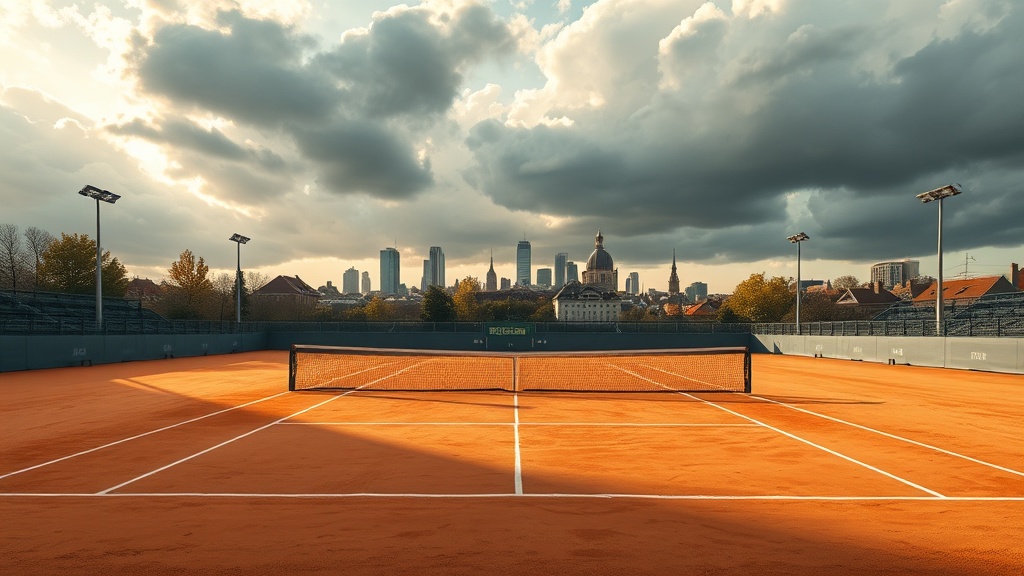
There is something almost defiant about holding an elite tennis tournament on clay in northern Germany in late July. The Hamburg European Open doesn’t announce itself with the neon urgency of a Miami night match or the aristocratic glow of Wimbledon. It just sits there, stubbornly European, resolutely slow, asking players to do something the modern tour increasingly resents: wait.
Patience is not a virtue the ATP prizes. The tour has spent two decades paving over clay—literally and figuratively—in favor of hard courts that favor big serving, short points, and the kind of athletic explosiveness that looks excellent on highlight reels. The results speak plainly. According to data compiled by Tennis Abstract, roughly 70 percent of ATP events now unfold on concrete. Clay has been relegated to a spring curiosity, a preamble to grass, a footnote.
And yet Hamburg endures.
A Tournament Out of Time
This year the men’s draw produced something genuinely unusual: a first-time champion, yes, but more importantly, a tournament that rewarded construction over demolition. Flavio Cobolli of Italy took the 2025 title. He is not a household name. He does not have a signature shoe line or a documentary crew trailing him through the players’ garden. What he has is a game built for dirt—heavy legs, heavy spins, the willingness to stand ten feet behind the baseline and trade blows until someone cracks.
The final was not pretty by the standards of the Tennis Twitter cognoscenti. It was long. It was physical. At times it resembled less a sporting contest than a labor negotiation between two exhausted parties. “You watch a match like that and you remember why the old guys used to talk about ‘building a point,’” a veteran stringer who has worked the Hamburg tournament since 2003 told me over coffee near the Rothenbaum grounds. “It’s not about the one shot. It’s about the ten shots before the one shot.”
He asked not to be named, presumably because the modern tennis economy does not reward nostalgia.
What the Rankings Hide
The Cobolli victory is the kind of result that makes the tour’s hagiography of the “top players” look increasingly like marketing collateral. The Hamburg draw this year included Alexander Zverev, the hometown favorite who has won the event before, and Andrey Rublev, who notched his 350th career win in Hamburg in 2025. Both are top-ten fixtures. Neither reached the final.
This is not an upset narrative. It is a surface narrative. Clay exposes. On hard courts, a player can survive a mediocre day with a big serve and a few clutch forehands. On Hamburg’s red dirt, the points extend, the lungs burn, and the technical deficiencies that power can hide on concrete become public record. The tournament is, in this sense, one of the last honest places on the calendar.
Which explains why so many stars treat it as a scheduling afterthought.
The Empire of Convenience
The professional game has become a logistics operation disguised as sport. Players now fly private between identical hard courts in Dubai, Indian Wells, Cincinnati, and Toronto, chasing ranking points on surfaces that might as well be poured from the same batch. The uniformity is efficient. It is also enervating.
Hamburg disrupts this. The clay demands different preparations, different timing, different muscles. The weather in late July is capricious. The city itself—port town, mercantile, famously unpretentious—offers none of the Instagram backdrops of Monte Carlo or the celebrity adjacencies of Miami. “You come here to play tennis,” one ATP coach remarked to a colleague within earshot of a reporter this year. “That is the entire pitch.”
There is a market logic to the hard-court takeover. It is easier to televise. It produces more reliable star winners. It travels well to American and Asian broadcast markets. But markets are not cultures, and the homogenization of the tour has begun to feel like the athletic equivalent of replacing every local restaurant with the same multinational chain. You can eat there. You will not remember the meal.
The Quiet Argument for Difference
The Hamburg Open will never again be what it was in the 1990s, when it held Masters status and attracted the full elite. That era is gone, and nostalgia is a weak foundation for policy. But the tournament still matters as a reminder that tennis does not have to be one thing. That a sport can contain multitudes—finesse and power, patience and aggression, clay and concrete—without collapsing into incoherence.
We do not need every tournament to be Hamburg. We need Hamburg to continue being Hamburg: inconvenient, unglamorous, and honest. In an age of algorithmic entertainment, there is something radical about a sporting event that refuses to speed up.
Cobolli will take his trophy home to Italy. The court crews will scrape the last of the clay from the Rothenbaum stadium. And the tour will move on, faster and harder and ever more uniform.
But the dirt remains. Waiting.
Sources
- Alexander Zverev “threw up 37 times” before second-round loss in Hamburg | Tennis.com
- ECE Ladies Hamburg Open 2024 Scores - WTA
- Bitpanda Hamburg Open Tournaments News | Tennis.com
- Men’s Tennis: Hamburg European Open, Singles Champions by Year
- 2025 Hamburg Open - Wikipedia
- MSC Hamburg Ladies Open 2025 Overview | WTA Official